WGU Behavioral Management questions and answers
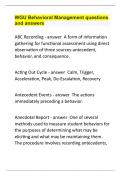
ABC Recording A form of information gathering for functional assessment using direct observation of three sources-antecedent, behavior, and consequence. Acting Out Cycle Calm, Trigger, Acceleration, Peak, De-Escalation, Recovery Antecedent Events The actions immediately preceding a behavior. Anecdotal Report One of several methods used to measure student behaviors for the purposes of determining what may be eliciting and what may be maintaining them. The procedure involves recording antecedents, behaviors, and consequences during a specified time period. Assertive In terms of teacher behavior, the setting of clear behavioral student limits, providing consistent follow-through, and rewarding students for appropriate actions. Canter's Assertive Discipline Aversive Stimulus Aversive stimulus: A stimulus that decreases the rate or probability of a behavior when presented as a consequence; as such, it is a type of punishment. Alternatively, the removal of an aversive stimulus following a behavior may increase the rate or probability of that behavior; as such, it is a negative reinforcer. Antecedent Strategies Positive changes in the environment that increase occurrence of replacement behavior and decrease situations which predict occurrence of problem behaviors. Part of BIP Antiseptic Bouncing Surface management technique in which a student might be sent on an errand to prevent disruptive behavior. Behavioral Intervention Plan Formal, written document that describes the environmental changes that will bring about change in a desired or undesired behavior. Behavior Modification Based on the work of psychologist B. F. Skinner, the systematic control of environmental events, especially through reinforcement and punishment, to produce change in observable behaviors. Behavioral Techniques Systematic use of antecedents and consequences to maintain or change behavior. Booster lessons Instructional lessons designed to reorient students to information they previously learned and to provide additional practice in skill development. Cognitions Mental activities ranging from random thinking to more complex and orderly problem solving, includes inner speech. Cognitive mediation Process of focusing on and adjusting thoughts such as beliefs, attitudes, and though processes in order to change behavior. Cognitive modeling same as Think Alouds Cognitive-behavioral approach Way of modifying behavior by first modifying cognition. Modeling, feedback, and reinforcement are used and how to think rather than what to think is emphasized. Cognitive-behavioral intervention Instructional strategies that use the cognitive-behavioral approach. Conduct Disorder students usually ignore rights of others, often cruel, deceitful, or truant Consequence Action immediately following a behavior. Consequence Strategies part of BIP- strategies to reinforce replacement behavior and take away reinforcement for problem behavior Contingent Activities Specific activities such as listening to music and eating lunch with the teacher that are used as rewards for appropriate behavior Continuous Schedule of Reinforcement Recommended when teaching students new behaviors or attempting to replace behaviors that are particularly strong or are inadvertently reinforced. It involves a one-to-one correspondence, such that every time the new or replacement behavior occurs, it is immediately reinforced. Cooperative Discipline Emphasizes the four purposes of behavior (attention getting, power, revenge, and helplessness) Social belonging is key so teachers may use a sociogram to see makeup of class. Crisis management plans Specific, step by step procedures,consistently applied and designed to allow teachers and other school professionals to coordinate efforts to effectively and safely respond to a crisis situation. Data Collection used to monitor progress, identify modifications to intervention, and monitor implementation fidelity in BIP Dead Man Test Fair pair test applied to target behavior that requires an action on the part of the student and an adaptive behavior rather than the simple absence of a behavior. If a dead man ca
Written for
- Institution
- D001 WGU
- Course
- D001 WGU
Document information
- Uploaded on
- May 17, 2024
- Number of pages
- 28
- Written in
- 2023/2024
- Type
- Exam (elaborations)
- Contains
- Questions & answers
Subjects
-
wgu behavioral management questions and answers

Also available in package deal