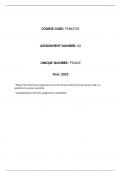
COURSE CODE: PDU3701
ASSIGNMENT NUMBER: 02
UNIQUE NUMBER: 899976
Year: 2023
*Please note that these assignments are from the year 2023 and may only be used as a
guideline to answer questions.
*Copying directly from this assignment is prohibited.
, Question 1:
Briefly discuss the following:
1.1 Communality:
According to (Philip Higgs, Moeketsi Letseka 2022) communality is another important
notion found in the traditional African thought and the notion of belonging to a
community of people establishes the actual fabric of traditional African life. This is in
contrast with the Western liberal notion of the individual where some sort of entity is
capable of existing and thriving on their own - unrelated to any community of other
individuals, not bound by any biological relationships, nor socio-economic-, political-,
and cultural relationships, duties, conventions and responsibilities which frame and
define a community of individuals.
The African philosopher John Mbiti described the communal notion of the individual
in many traditional African settings as the following: “whatever happens to the
individual happens to the whole group, whatever happens to the whole group
happens to the individual. Individuals can say; I am, because we are and since we are,
therefore I am” (Philip Higgs, Moeketsi Letseka 2022).
1.2 A fact:
Human beings live in a world full of facts which is our everyday experiences and the
world we see around us. Daily, we use our senses and experiences without even
realising of seeing it in order to create and check facts which is the most reliable form
of knowledge and information we have. We trust what our senses tell us, and we
believe that the people around us hear, feel and see the same things we do (Philip
Higgs, Moeketsi Letseka 2022).
Philip Higgs, Moeketsi Letseka 2022, states that Empiricism divides facts into two
groups:
Facts that are true by definition: There is no need to check if this is true, for
example; we know for a fact 2 + 2 = 4 and a square is not a triangle.
and
Facts that can be proven to be true: These are scientific facts (e.g., Mercury is a
planet) and everyday facts (e.g., the red traffic light means stop).
ASSIGNMENT NUMBER: 02
UNIQUE NUMBER: 899976
Year: 2023
*Please note that these assignments are from the year 2023 and may only be used as a
guideline to answer questions.
*Copying directly from this assignment is prohibited.
, Question 1:
Briefly discuss the following:
1.1 Communality:
According to (Philip Higgs, Moeketsi Letseka 2022) communality is another important
notion found in the traditional African thought and the notion of belonging to a
community of people establishes the actual fabric of traditional African life. This is in
contrast with the Western liberal notion of the individual where some sort of entity is
capable of existing and thriving on their own - unrelated to any community of other
individuals, not bound by any biological relationships, nor socio-economic-, political-,
and cultural relationships, duties, conventions and responsibilities which frame and
define a community of individuals.
The African philosopher John Mbiti described the communal notion of the individual
in many traditional African settings as the following: “whatever happens to the
individual happens to the whole group, whatever happens to the whole group
happens to the individual. Individuals can say; I am, because we are and since we are,
therefore I am” (Philip Higgs, Moeketsi Letseka 2022).
1.2 A fact:
Human beings live in a world full of facts which is our everyday experiences and the
world we see around us. Daily, we use our senses and experiences without even
realising of seeing it in order to create and check facts which is the most reliable form
of knowledge and information we have. We trust what our senses tell us, and we
believe that the people around us hear, feel and see the same things we do (Philip
Higgs, Moeketsi Letseka 2022).
Philip Higgs, Moeketsi Letseka 2022, states that Empiricism divides facts into two
groups:
Facts that are true by definition: There is no need to check if this is true, for
example; we know for a fact 2 + 2 = 4 and a square is not a triangle.
and
Facts that can be proven to be true: These are scientific facts (e.g., Mercury is a
planet) and everyday facts (e.g., the red traffic light means stop).