

100% satisfaction guarantee Immediately available after payment Both online and in PDF No strings attached 4.2 TrustPilot
logo-home
Exam (elaborations)

EMA1501 Assignment 2 (COMPLETE ANSWERS) 2024 - DUE 3 June 2024

Rating
5.0
(1)
Sold
2
Pages
14
Grade
A+
Uploaded on
15-05-2024
Written in
2023/2024

EMA1501 Assignment 2 (COMPLETE ANSWERS) 2024 - DUE 3 June 2024 ;100% TRUSTED workings, explanations and soluti ons. for assistance Whats-App.......0.6.7..1.7.1..1.7.3.9....... QUESTION 1 Mathematics does not happen in a vacuum but is part of an integrated approach to the child’s development. Mathematics should be embedded and integrated in all the activities the children engage in throughout the day, such as feeding time, playtime, rest/sleep time, routine morning, midday and evening activities, etc. 1.1. Define Emergent Mathematics. (4) 1.2. Think of a story or stories you were told as a child. Think about any part of the story that had mathematical themes, concepts or ideas and in a paragraph of between 8 to 10 lines or 100 words, relate the memories and mathematical concepts you learned from the story. (10) 1.3. Play is often referred to as a child’s work, and that it is very important for learning. In a paragraph of 5 to 6 lines, examine the relationship between play and emergent mathematics. (6) Downloaded by Corona Virus () lOMoARcPSD| 6 1.4. There are theories that are implicated in the teaching and learning of emergent mathematics in the early years. Create a three-column table where you discuss how teaching and learning takes place according to Piaget, Vygotsky and Bruner. (30) (50) QUESTION 2 The teaching of number sense in the early years is the very foundation of the teaching and learning of mathematics. 2.1. • Differentiate between rote counting and rational counting. (2) • Provide an example of an activity to demonstrate your understanding of each type of counting. (2x2=4) 2.2. In a paragraph of 4 to 6 lines or 80 words, justify the use of basic technology in teaching number sense. (4) 2.3. Read the scenario below, and answer the questions that follow: Mpho turned 5 years on the 3rd of February. His mom decided to have a party at school with all thirty children in his class. But on the day of the party, 2 more children were enrolled in Mpho’s class. Mpho’s mom provided only 30 cupcakes, 30 sweets, 30 apples, and 6 2-litre bottles of orange juice – exactly enough for thirty children. Mpho had a big, rectangular birthday cake decorated with colourful Smarties. After the party, the children had fun playing outdoor games in groups of five. Downloaded by Corona Virus () lOMoARcPSD| EMA1501 ASSESSMENT 2/0/2024 7 2.3.1. Identify five mathematical concepts that can be developed through Mpho’s party. (5) 2.3.2. Illustrate how each of these concepts can be developed through the activities from Mpho’s party. (5) 2.3.3. Write down an activity you can do at the party, to teach the children problem-solving. (5) [25] QUESTION 3 Patterning is one of the basic mathematical skills children develop in the early years to be used as a foundation to understand more complex concepts. 3.1. In light of the above statement, discuss the importance of patterning and how it contributes to counting strategy development, problem-solving and generalizations about number combinations. You may include the following in your discussions. • First identify different types of patterns using examples and explain the rules used in these patterns (You may consider patterns in sound/rhythm, movement, concrete objects, colour, shape and size.) (5) • Discuss how these patterns contribute to an understanding of counting and mathematical concepts. (5) 3.2. During teaching practice at a school, ask permission from the mentor teacher to plan a movement pattern suitable for grade R learners. • Write down the steps you will follow and the instructions you will give. (5x2 10) • Try it out with the learners and write a short reflection on how it went and what if, anything, you would change if you had to do it again. (5)

Show more Read less
Institution
Course


Whoops! We can’t load your doc right now. Try again or contact support.

Connected book

Written for

Institution
Course

Document information

Uploaded on
May 15, 2024
Number of pages
14
Written in
2023/2024
Type
Exam (elaborations)
Contains
Questions & answers

Subjects

Content preview

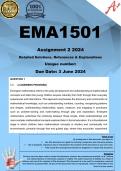
EMA1501
Assignment 2 2024
Detailed Solutions, References & Explanations

Unique number:

Due Date: 3 June 2024
QUESTION 1

1.1. (2 ANSWERS PROVIDED)

Emergent mathematics refers to the early development and understanding of mathematical
concepts and skills that young children acquire naturally from birth through their everyday
experiences and interactions. This approach emphasizes the discovery and construction of
mathematical knowledge, such as understanding numbers, counting, recognizing patterns
and shapes, understanding relationships, space, measure, and engaging in processes
such as problem-solving and mark-making through play and exploration. Emergent
mathematics underlines the continuity between these simple, initial understandings and
more complex mathematical concepts explored later in formal education. It is a foundational
stage in which children learn mathematical concepts in intuitive and contextually rich
environments, primarily through free and guided play, where they encounter, experiment
with, and begin to understand the mathematical aspects of the world around them.
Terms of use
By making use of this document you agree to:
• Use this document as a guide for learning, comparison and reference purpose,
• Not to duplicate, reproduce and/or misrepresent the contents of this document as your own work,
• Fully accept the consequences should you plagiarise or misuse this document.


Disclaimer
Extreme care has been used to create this document, however the contents are provided “as is” without
any representations or warranties, express or implied. The author assumes no liability as a result of
reliance and use of the contents of this document. This document is to be used for comparison, research
and reference purposes ONLY. No part of this document may be reproduced, resold or transmitted in any
form or by any means.


Reviews from verified buyers

Showing all reviews
1 year ago

5.0

1 reviews

5
1
4
0
3
0
2
0
1
0
Trustworthy reviews on Stuvia

All reviews are made by real Stuvia users after verified purchases.

Get to know the seller

Seller avatar
Reputation scores are based on the amount of documents a seller has sold for a fee and the reviews they have received for those documents. There are three levels: Bronze, Silver and Gold. The better the reputation, the more your can rely on the quality of the sellers work.
EduPal University of South Africa (Unisa)
Follow You need to be logged in order to follow users or courses
Sold
149205
Member since
7 year
Number of followers
35996
Documents
4352
Last sold
7 hours ago

4.2

13562 reviews

5
7808
4
2689
3
1791
2
455
1
819

Recently viewed by you

Why students choose Stuvia

Created by fellow students, verified by reviews

Quality you can trust: written by students who passed their tests and reviewed by others who've used these notes.

Didn't get what you expected? Choose another document

No worries! You can instantly pick a different document that better fits what you're looking for.

Pay as you like, start learning right away

No subscription, no commitments. Pay the way you're used to via credit card and download your PDF document instantly.

Student with book image

“Bought, downloaded, and aced it. It really can be that simple.”

Alisha Student

Frequently asked questions


