WSU HD 101 Exam 2 fully solved and updated
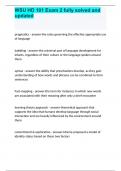
pragmatics - answer-the rules governing the effective appropriate use of language babbling - answer-the universal part of language development for infants, regardless of their culture or the language spoken around them syntax - answer-the ability that preschoolers develop, as they gain understanding of how words and phrases can be combined to form sentences Fast-mapping - answer-the term for instances in which new words are associated with their meaning after only a brief encounter learning theory approach - answer-theoretical approach that supports the idea that humans develop language through social interaction and are heavily influenced by the environment around them commitment & exploration - answer-Marcia proposed a model of identity status based on these two factors social comparison - answer-this begins in middle childhood, as children's self-concept begins to be influenced by peers and academic achievement crisis - answer-according to Marcia, an individual must experience this in order to arrive at identity achievement foreclosure - answer-commitment without exploration will result in this identity status autonomy, competence, & connectedness - answer-according to Self Determination Theory, self-esteem is associated with these three factors gender - answer-the therm for the perception of oneself as male or female preschool age - answer-gender is well established by the time children are this age parental understanding - answer-the most powerful predictor of positive adjustment for LGBT youth permissiveness with affection - answer-according to current norms, if sexual intercourse occurs within the context of a long-term, committed, or loving relationship, it is called this 1)Feeling different (6-12 yrs) 2)Confusion 3)self-acceptance - answer-the common path to "coming out" is functional play - answer-the term for play that involves simple, repetitive activities typical of 3-year-olds parallel play - answer-type of play that involves action in which children play with similar toys in a similar manner, but they do not interact with one another status - answer-adolescent boys typically organize their social groups based on this blended family - answer-remarried couple that has stepchildren from previous marriages living with them is called this sandwich generation - answer-couples in middle age that must fulfill the needs of both their children and their aging parents are called acculturation - answer-this refers to the changes and adjustments that occur when groups of different people come into sustained firsthand contact assimilation - answer-adopting the values and beliefs of the majority culture, while being weakly identified with your own culture Marginalization - answer-adopting neither the majority culture or the minority culture Integration - answer-maintaining your own culture while also adopting majority culture Separation - answer-maintaining your own culture while rejecting the majority culture age - answer-the extent of identification with one's own ethnicity increases with this Head Start - answer-the best-known program designed to promote future academic success, born in the 1960s for the War on Poverty controversial - answer-an adolescent student who is liked by some and disliked by others is considered this popular - answer-an adolescent who is mostly liked by everyone rejected - answer-an adolescent who is mostly disliked by others neglected - answer-an adolescent who is unknown by others diffusion - answer-identity status with not much commitment or exploration moratorium - answer-identity status with a lot of exploration, but little commitment achievement - answer-identity status that includes a lot of exploration in order to find the right thing to be committed to moratorium & achievement - answer-the 2 identity statuses that are considered to be healthy states of identity for adolescents Authoritarian - answer-parents who are cold with control, punitive, their word is law unsociable, withdrawn - answer-children of authoritarian parents Permissive - answer-parents who are warm and lax, give inconsistent feedback, and expect little of their children dependent, moody, low self-control - answer-children of permissive parents Authoritative - answer-parents who are warm with control, set firm and clear expectations for children, and reason with them friendly, cooperative, self-assertive - answer-children of authoritative parents Uninvolved - answer-parents who are cold and lax, show little interest in their children, have rejecting behavior detached from parent and peers - answer-children of uninvolved parents L - answer-Let your affection show E - answer-Express pain away from your child A - answer-Avoid rejecting behaviors D - answer-Do good before you feel good Nativist approach - answer-theory that language is an innate skill Interactionist perspective - answer-incorporates both learning theory and nativist approaches identity vs. identity confusion stage - answer-Erikson's theory that says this is the time when adolescents figure out uniqueness, strive to find their strengths and weaknesses, and suitable future roles Social clock - answer-psychological timepiece that gives a sense of attainment of major markers of life as early, late, or right on time the 4 C's of Career Consolidation - answer-Contentment, compensation, competence, & commitment to work identity Prosocial behavior - answer-helping behavior that benefits others Pre conventional morality - answer-Stages 1 & 2 of Kohlberg's model of morality, based on punishment and reward (infancy) Conventional morality - answer-Stages 3 & 4 of Kohlberg's model of morality, children approach problems as members of society (school age) Post conventional morality - answer-Stages 5 & 6 of Kohlberg's model of morality, people use moral principles than are broader than those of a particular society (adulthood) Gilligan's Stage 1 - answer-Orientation toward individual survival Gilligan's Stage 2 - answer-goodness as self-sacrifice Gilligan's Stage 3 - answer-Morality of nonviolence Diana Baurind - answer-Person who developed the 4 types of parenting High-warmth parent - answer-Accepting, caring Low-warmth parent - answer-rejecting, unresponsive, parent-centered vs. child-centered High-control parent - answer-demanding expectations, intrusive, manipulating Low-control parent - answer-lower expectations of maturity, uninvolved, lack of boundaries Sex - answer-sexual anatomy & behavior Corpus callosum - answer-the bundle of nerves that connect the two hemispheres of the brain; larger in women than men gender schema - answer-cognitive framework that organizes information relevant to gender gender constancy - answer-awareness that people are permanently male or female (developed at age 4-5) Double standard - answer-pre-marital sex is permissible for boys but not for girls transsexual - answer-feeling trapped in the body of opposite gender Intersex/hermaphrodite - answer-born with a combination of sexual organs (1 in 4,500 births) Passionate love - answer-state of powerful absorption with someone Compassionate love - answer-strong affection for those w/whom our lives are deeply involved Labeling theory of passionate love - answer-individuals experience romantic love when there is 1) intense physiological arousal 2) situational cues suggesting arousal is due to love Steinberg's triangular theory - answer-intimacy, passion, & commitment Nonlove - answer-how we may feel towards a waiter (no commitment, intimacy, or passion) Liking - answer-only intimacy Infatuated love - answer-only passion empty love - answer-only commitment fatuous love - answer-passion and commitment, but no intimacy romantic love - answer-intimacy and passion, but no commitment companionate love - answer-intimacy and commitment, but no passion consumate love - answer-all components of love are present constructive play - answer-play that children manipulate objects to build or produce something onlooker play - answer-children simply watch others play associative play - answer-2 or more children interact by sharing or borrowing toys, but don't play the same ways cooperative play - answer-children genuinely interact with one another, take turns, play games, and devise contests Damon's Stages of friendship - answer-1)Based on other's behavior 2)Based on trust 3)based on psychological closeness Proximity, similarity, & culture - answer-The things adults base friendships on trust, loyalty, supportiveness, & sense of humor - answer-Qualities adults seek in friendships Empty-nest syndrome - answer-temporary feelings of sadness/loss when a child moves out Long. term outcomes of an empty nest - answer-Higher marital satisfaction, lower stress Helicopter parents - answer-intrusively intervene in children's lives, micromanage child's college career Boomerang children - answer-young adults who come back to live with their parents Child care center - answer-child care provided while parents work Family child care center - answer-child care provided in private homes Preschool - answer-Child care that provides intellectual and social experiences with more structure and training School child care - answer-child care and education with in school district Sterotype - answer-a belief/expectation about members of a minority group Prejudice - answer-negative/positive evaluations or judgements or members in a group Discrimination - answer-negative/positive actions taken toward members of a particular group social learning view of prejudice - answer-prejudice develops the same way as attitudes, values, & beliefs social identity theory of prejudice - answer-use group membership as source of pride & self-worth evolutionary theory of prejudice - answer-humans who look like me are more likely to be in-group Gilligan's Stage 1 - answer-
Written for
- Institution
- WSU
- Course
- WSU
Document information
- Uploaded on
- May 15, 2024
- Number of pages
- 14
- Written in
- 2023/2024
- Type
- Exam (elaborations)
- Contains
- Questions & answers
Subjects
-
wsu hd 101 exam 2 fully solved and updated

Also available in package deal