Conformity: types and explanations:
- Conformity – change in behaviour or opinions as a result of real/imagined pressure from
person/group
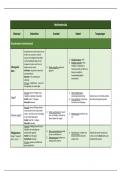
- Kelman (1958) – 3 types of conformity
o Internalisation – deep – take on majority view and accept it – change even when
group is absent
o Identification – moderate – act in same way as group because they want to be part
of it – change not present when group is absent
o Compliance – superficial – outwardly go along with group but privately disagree
- Two process theory – Deutsch and Gerard (1955)
o Informational social influence – explanation that we agree with opinion of majority
because we believe it is correct – lead to internalisation
o Normative social influence – explanation that we agree because we want to be
accepted, gain social approval and be liked – lead to compliance
Strengths Weaknesses
Support for Informational – conform when do ISI and NSI together
not know the answer - Most often both processes involved –
- Lucas et al (2006) – students to answer not able to distinguish/separate
mathematical problems of varying Individual differences in normative
difficulty – greater conformity to - Does not always affect everyone the
incorrect answers when they were same way – nAffiliators care more
difficult and most true for lower about being liked, those who were NOT
mathematical ability students nAffiliators are less likely to conform
Support for normative Individual differences in informative
- Asch (1951) – ppts went along with - Perrin and Spencer (1980) – science
wrong answers just because others did and engineering students who were
– when writing answers, conformity more confident were less likely to
dropped to 12.5% conform on hard trials
Conformity: Asch (1951):
- Ppts – 123 students – 50 were naïve participants, rest were confederates
- Method – reference card with line to judge against 3 others – answers given aloud in group
setting, naïve participant was second to last to give answer
o 12 of 18 trials were critical (conformity induced)
- Findings
o Overall conformity – 36.8%
25% never conformed, 75% conformed at least once
o Ppt interviews said it was normative social influence
- Variations
o Group size – 3 = optimal number of confederates, levelled out in terms of
conformity afterwards
o Unanimity – one confederate went against majority (not always right) – pressure on
naïve participant reduced = conformity reduced to 25%
o Task difficulty – more difficult task = more conformity – informational SI
Weaknesses
- Conformity – change in behaviour or opinions as a result of real/imagined pressure from
person/group
- Kelman (1958) – 3 types of conformity
o Internalisation – deep – take on majority view and accept it – change even when
group is absent
o Identification – moderate – act in same way as group because they want to be part
of it – change not present when group is absent
o Compliance – superficial – outwardly go along with group but privately disagree
- Two process theory – Deutsch and Gerard (1955)
o Informational social influence – explanation that we agree with opinion of majority
because we believe it is correct – lead to internalisation
o Normative social influence – explanation that we agree because we want to be
accepted, gain social approval and be liked – lead to compliance
Strengths Weaknesses
Support for Informational – conform when do ISI and NSI together
not know the answer - Most often both processes involved –
- Lucas et al (2006) – students to answer not able to distinguish/separate
mathematical problems of varying Individual differences in normative
difficulty – greater conformity to - Does not always affect everyone the
incorrect answers when they were same way – nAffiliators care more
difficult and most true for lower about being liked, those who were NOT
mathematical ability students nAffiliators are less likely to conform
Support for normative Individual differences in informative
- Asch (1951) – ppts went along with - Perrin and Spencer (1980) – science
wrong answers just because others did and engineering students who were
– when writing answers, conformity more confident were less likely to
dropped to 12.5% conform on hard trials
Conformity: Asch (1951):
- Ppts – 123 students – 50 were naïve participants, rest were confederates
- Method – reference card with line to judge against 3 others – answers given aloud in group
setting, naïve participant was second to last to give answer
o 12 of 18 trials were critical (conformity induced)
- Findings
o Overall conformity – 36.8%
25% never conformed, 75% conformed at least once
o Ppt interviews said it was normative social influence
- Variations
o Group size – 3 = optimal number of confederates, levelled out in terms of
conformity afterwards
o Unanimity – one confederate went against majority (not always right) – pressure on
naïve participant reduced = conformity reduced to 25%
o Task difficulty – more difficult task = more conformity – informational SI
Weaknesses