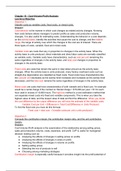
Chapter 19 - Cost-Volume-Profit Analysis
Learning Objective
Objective 1:
Classify costs as variable costs, fixed costs, or mixed costs.
Answer:
Cost behavior is the manner in which cost changes as related activity changes. Knowing
how costs behave allows managers to predict profits as sales and production volume,
changes. It is also useful for estimating costs. Understanding the behavior or a cost depends
on the activity bases, Identify the activities that cause the cost to change, and the relative
range, the range of activity over which the changes in the cost are of interest. There are
three types of costs, variable, fixed and mixed costs.
Variable costs are costs that vary in proportion to changes in the activity base. When the
activity base is units produced, direct materials and direct labor costs are normally classified
as variable costs. Variable costs have characteristics, such as cost per unit remaining the
same regardless of changes in the activity base, and total cost changes in proportion to
changes in the activity base.
Fixed costs are costs that remain the same in total dollar amount as the activity base
changes. When the activity base is units produced, many factory overhead costs such as
straight-line depreciation are classified as fixed costs. Fixed costs have characteristics like
the cost per unit decreases as the activity level increases and increases as the activity level
decreases, and the total cost remains the same regardless of changes in the activity base.
Mixed costs are costs that have characteristics of both variable and a fixed cost. An example
would be a rental charge if the contract is: Rental charge = $15,000 per year + $1 for each
hour used in excess of 10,000 hours. The high-low method is a cost estimation method that
can separate mixed costs into fixed and variable components. This is when you take the
highest value of data, and the lowest value of data and find the difference. When you divide
the cost difference by the output difference you will have the estimate of the variable costs.
Variable Cost per Unit = Difference in Total Cost/Difference in Units Produced
To find the fixed cost you must do this formula:
Fixed cost = total cost - (Variable costs per unit x units produced.)
Objective 2:
Compute the contribution margin, the contribution margin ratio, and the unit contribution
margin.
Answer:
Cost-Volume-Profit analysis is the examination of the relationship among selling prices,
sales and production volume, costs, expenses, and profit. CVP is useful for managerial
decision making such as:
● Analyzing the effects of changes in selling prices on profits.
● Analyzing the effects of changes in costs on profit.
● Analyzing the effects of changes in volume on profits.
● Setting selling prices
● Selecting the mix of products to sell
● Choosing among marketing strategies
Contribution margin is especially useful because it provides insight into the profit potential of
Learning Objective
Objective 1:
Classify costs as variable costs, fixed costs, or mixed costs.
Answer:
Cost behavior is the manner in which cost changes as related activity changes. Knowing
how costs behave allows managers to predict profits as sales and production volume,
changes. It is also useful for estimating costs. Understanding the behavior or a cost depends
on the activity bases, Identify the activities that cause the cost to change, and the relative
range, the range of activity over which the changes in the cost are of interest. There are
three types of costs, variable, fixed and mixed costs.
Variable costs are costs that vary in proportion to changes in the activity base. When the
activity base is units produced, direct materials and direct labor costs are normally classified
as variable costs. Variable costs have characteristics, such as cost per unit remaining the
same regardless of changes in the activity base, and total cost changes in proportion to
changes in the activity base.
Fixed costs are costs that remain the same in total dollar amount as the activity base
changes. When the activity base is units produced, many factory overhead costs such as
straight-line depreciation are classified as fixed costs. Fixed costs have characteristics like
the cost per unit decreases as the activity level increases and increases as the activity level
decreases, and the total cost remains the same regardless of changes in the activity base.
Mixed costs are costs that have characteristics of both variable and a fixed cost. An example
would be a rental charge if the contract is: Rental charge = $15,000 per year + $1 for each
hour used in excess of 10,000 hours. The high-low method is a cost estimation method that
can separate mixed costs into fixed and variable components. This is when you take the
highest value of data, and the lowest value of data and find the difference. When you divide
the cost difference by the output difference you will have the estimate of the variable costs.
Variable Cost per Unit = Difference in Total Cost/Difference in Units Produced
To find the fixed cost you must do this formula:
Fixed cost = total cost - (Variable costs per unit x units produced.)
Objective 2:
Compute the contribution margin, the contribution margin ratio, and the unit contribution
margin.
Answer:
Cost-Volume-Profit analysis is the examination of the relationship among selling prices,
sales and production volume, costs, expenses, and profit. CVP is useful for managerial
decision making such as:
● Analyzing the effects of changes in selling prices on profits.
● Analyzing the effects of changes in costs on profit.
● Analyzing the effects of changes in volume on profits.
● Setting selling prices
● Selecting the mix of products to sell
● Choosing among marketing strategies
Contribution margin is especially useful because it provides insight into the profit potential of