Chapter 11 - Public Goods and Common Resources
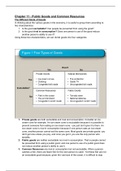
The Different Kinds of Goods
In thinking about the various goods in the economy, it is useful to group them according to
two characteristics:
1. Is the good excludable? Can people be prevented from using the good?
2. Is the good rival in consumption? Does one person’s use of the good reduce
another person’s ability to use it?
Using these two characteristics, we can divide goods into four categories
1. Private goods are both excludable and rival and consumption. Consider an ice
cream cone for example. An ice-cream cone is excludable because it is possible to
prevent someone from eating an ice-cream cone - you just don't give it to them. An
ice-cream cone is rival in consumption because if one person eats an ice-cream
cone, another person cannot eat the same cone. Most goods are private goods: you
don't get one unless you pay, and once you get it, you are the only person who
benefits.
2. Public goods are neither excludable nor rival in consumption. That is people cannot
be prevented from using a public good, and one person’s use of a public good does
not reduce another person’s ability to use it.
3. Common Resources are rival in consumption but not excludable. When a person
catches a fish, there are fewer fish for the next person to catch. Yet these fish are not
an excludable good because, given the vast size of the ocean, it is difficult to stop
The Different Kinds of Goods
In thinking about the various goods in the economy, it is useful to group them according to
two characteristics:
1. Is the good excludable? Can people be prevented from using the good?
2. Is the good rival in consumption? Does one person’s use of the good reduce
another person’s ability to use it?
Using these two characteristics, we can divide goods into four categories
1. Private goods are both excludable and rival and consumption. Consider an ice
cream cone for example. An ice-cream cone is excludable because it is possible to
prevent someone from eating an ice-cream cone - you just don't give it to them. An
ice-cream cone is rival in consumption because if one person eats an ice-cream
cone, another person cannot eat the same cone. Most goods are private goods: you
don't get one unless you pay, and once you get it, you are the only person who
benefits.
2. Public goods are neither excludable nor rival in consumption. That is people cannot
be prevented from using a public good, and one person’s use of a public good does
not reduce another person’s ability to use it.
3. Common Resources are rival in consumption but not excludable. When a person
catches a fish, there are fewer fish for the next person to catch. Yet these fish are not
an excludable good because, given the vast size of the ocean, it is difficult to stop