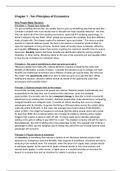
Chapter 1 - Ten Principles of Economics
How People Make Decision
Principles 1: People face trade-offs
“To get something that we like, we usually have to give up something else that we also like.”
Consider a student who must decide how to allocate her most valuable resource - her time.
She can spend all of her time studying economics, spend all of it studying psychology, or
divide it between the two fields. When people are grouped into societies, they face different
kinds of trade-offs. One classic trade-off is between “guns and butter.” The more a society
spends on national defense (guns), the less it can spend on consumer goods (butter) to
raise the standards of living at home. Another trade-off society faces is between efficiency
and equality. Efficiency means that society is getting the maximum benefits from its scarce
resources. Equality means that those benefits are distributed uniformly among society’s
members. In other words, efficiency refers to the size of the economic pie and equality refers
to how the pie is divided into individual slices.
Principle 2: The cost of something is what you give up to get it.
“Because people face trade-offs, making decisions requires comparing the costs and
benefits of alternative courses of action.” Consider the decision to go to college, the main
benefits are intellectual enrichment and a lifetime of better job opportunities. But what are
the costs? The opportunity cost of an item is what you give up to get that item. When
making any decision, decision makers should be aware of the opportunity costs that
accompany each possible action.
Principle 3: Rational people think at the margin.
Economists normally assume that people are rational. Rational people systematically and
purposefully do the best they can to achieve their objectives, given the available
opportunities. Economists use the term marginal change to describe a small incremental
adjustment to an existing plan of action. Rational people often make decisions by comparing
marginal benefits and marginal costs. Consider an airline deciding how much to charge
passengers who fly standby. Suppose that flying a 200-seat plane across the united states
costs the airline $100,000. In this case, the average cost of each seat is $100,000/200,
which is $500. One might be tempted to conclude that the airline should never sell a ticket
for less than $500. But a rational airline can increase its profits by thinking at the margin.
Imagine that a plane is about to take off with 10 empty seats and a standby passenger
waiting at the gate is willing to pay $300 for a seat. The airplane company will sell the seat to
that passenger, the cost of adding one more passenger is tiny. The average cost of flying a
passenger is $500, but the marginal cost is merely the cost of the can of soda that the extra
passenger will consume.
Principle 4: People resond to incentives
An incentive is something that induces a person to act. Because rational people make
decisions by comparing costs and benefits, they respond to incentives. Incentives are key to
analyzing how markets work. For example, when the price of an apple rises, people decide
to eat fewer apples. At the same time, apple orchards decide to hire more workers and
harvest more apples. In other words, a higher price in a market provides an incentive for
buyers to consume less and an incentive for sellers to produce more.
How People Make Decision
Principles 1: People face trade-offs
“To get something that we like, we usually have to give up something else that we also like.”
Consider a student who must decide how to allocate her most valuable resource - her time.
She can spend all of her time studying economics, spend all of it studying psychology, or
divide it between the two fields. When people are grouped into societies, they face different
kinds of trade-offs. One classic trade-off is between “guns and butter.” The more a society
spends on national defense (guns), the less it can spend on consumer goods (butter) to
raise the standards of living at home. Another trade-off society faces is between efficiency
and equality. Efficiency means that society is getting the maximum benefits from its scarce
resources. Equality means that those benefits are distributed uniformly among society’s
members. In other words, efficiency refers to the size of the economic pie and equality refers
to how the pie is divided into individual slices.
Principle 2: The cost of something is what you give up to get it.
“Because people face trade-offs, making decisions requires comparing the costs and
benefits of alternative courses of action.” Consider the decision to go to college, the main
benefits are intellectual enrichment and a lifetime of better job opportunities. But what are
the costs? The opportunity cost of an item is what you give up to get that item. When
making any decision, decision makers should be aware of the opportunity costs that
accompany each possible action.
Principle 3: Rational people think at the margin.
Economists normally assume that people are rational. Rational people systematically and
purposefully do the best they can to achieve their objectives, given the available
opportunities. Economists use the term marginal change to describe a small incremental
adjustment to an existing plan of action. Rational people often make decisions by comparing
marginal benefits and marginal costs. Consider an airline deciding how much to charge
passengers who fly standby. Suppose that flying a 200-seat plane across the united states
costs the airline $100,000. In this case, the average cost of each seat is $100,000/200,
which is $500. One might be tempted to conclude that the airline should never sell a ticket
for less than $500. But a rational airline can increase its profits by thinking at the margin.
Imagine that a plane is about to take off with 10 empty seats and a standby passenger
waiting at the gate is willing to pay $300 for a seat. The airplane company will sell the seat to
that passenger, the cost of adding one more passenger is tiny. The average cost of flying a
passenger is $500, but the marginal cost is merely the cost of the can of soda that the extra
passenger will consume.
Principle 4: People resond to incentives
An incentive is something that induces a person to act. Because rational people make
decisions by comparing costs and benefits, they respond to incentives. Incentives are key to
analyzing how markets work. For example, when the price of an apple rises, people decide
to eat fewer apples. At the same time, apple orchards decide to hire more workers and
harvest more apples. In other words, a higher price in a market provides an incentive for
buyers to consume less and an incentive for sellers to produce more.