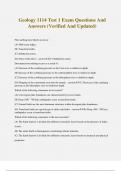
Geology 1114 Test 1 Exam Questions And Answers (Verified And Updated)
Geology 1114 Test 1 Exam Questions And Answers (Verified And Updated) Flux melting most likely occurs at: (A) Mid-ocean ridges. (B) Transform faults. (C) Subduction zones. (D) None of the above - answer(C) Subduction zones. Decompression melting occurs as a result of: (A) Decrease of the confining pressure as the Core rises to shallower depth. (B) Increase of the confining pressure as the asthenosphere rises to shallower depth. (C) Decrease of the confining pressure as the lithosphere rises to shallower depth. (D) Plunging of the continental crust into the mantle. - answer(C) Decrease of the confining pressure as the lithosphere rises to shallower depth. Which of the following statements in not correct? (A) Convergent plate boundaries are characterized by reverse faults. (B) Deep (300 - 700 km) earthquakes occur at transform faults. (C) Normal faults are the most dominant structures within divergent plate boundaries. (D) Transform faults are special type of strike-slip faults. - answer(B) Deep (300 - 700 km) earthquakes occur at transform faults. Which of the following statements is the most accurate? (A) The Earth interior is divided into different concentric layers based on the presence of index fossils. (B) The entire Earth is homogenous constituting silicate minerals. (C) The Earth interior is divided into different concentric layers based on chemical and physical properties. (D) The Earth interior structure constitutes a cluster of hexagonal cells similar to a honey cone - answer(C) The Earth interior is divided into different concentric layers based on chemical and physical properties Ophiolites are: (A) Pieces of the oceanic crust brought to the surface through tectonic plates collision. (B) Contain pillow basalt. (C) They are 7-8 km in thickness if intact. (D) All of the above. - answer(D) All of the above. The relatively cool and brittle tectonic plate is called: (A) Asthenosphere. (B) Crust. (C) Atmosphere (D) Lithosphere - answer(D) Lithosphere The rock that formed from the crystallization of molten magma is called: (A) Indigenous. (B) Igneous. (C) Metamorphic. (D) Sedimentary. - answer(B) Igneous. Igneous rocks that are formed through crystallization of lavas at the surface are called: (A) Sedimentary rocks. (B) Metamorphic rocks. (C) Volcanic rocks or extrusive. (D) Plutonic rocks or intrusive. - answer(C) Volcanic rocks or extrusive. Igneous rocks that are formed through crystallization of magmas at some depth are called: (A) Sedimentary rocks. (B) Metamorphic rocks. (C) Volcanic rocks. (D) Plutonic rocks. - answer(D) Plutonic rocks. Mantle plumes can best be described as: (A) Mantle melts that rises from the core-mantle boundary to reach the Earth surface and erupt in the form of Large Igneous Provinces (LIPs). (B) The sinking of the subducted slabs in the asthenosphere. (C) The production of huge amount of mantle melts because of Earth's polarity reversal. (D) Mantle melts that are generated from the core, interact with the asthenosphere, and intrude the crust to form granitic batholiths. - answer(A) Mantle melts that rises from the core-mantle boundary to reach the Earth surface and erupt in the form of Large Igneous Provinces (LIPs). Which of the following statements is not correct? (A) Metamorphic rocks may melt to magma. (B) Sedimentary rocks may weather to igneous rocks. (C) Magma crystallizes to form igneous rocks. (D) Igneous rocks can undergo metamorphism. - answer(B) Sedimentary rocks may weather to igneous rocks. The core is dominantly made-up of: (A) Iron and nickel. (B) Basalt (C) Granite (D) Peridotite. - answer(A) Iron and nickel. Which of the following is the thinnest layer of the Earth? (A) The mantle. (B) The outer core. (C) The inner core. (D) The crust. - answer(D) The crust. Continent-continent collision can be exemplified by: (A) The Arabian plate subducted under the African plate under the Red Sea.
Written for
- Institution
- Geology
- Course
- Geology
Document information
- Uploaded on
- May 12, 2024
- Number of pages
- 21
- Written in
- 2023/2024
- Type
- Exam (elaborations)
- Contains
- Questions & answers
Subjects
-
geology 1114 test 1 exam questions and answers ve

Also available in package deal