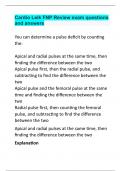
Cardio Leik FNP Review exam questions and answers.
You can determine a pulse deficit by counting the: Apical and radial pulses at the same time, then finding the difference between the two Apical pulse first, then the radial pulse, and subtracting to find the difference between the two Apical pulse and the femoral pulse at the same time and finding the difference between the two Radial pulse first, then counting the femoral pulse, and subtracting to find the difference between the two Apical and radial pulses at the same time, then finding the difference between the two Explanation The pulse deficit is the difference between the apical pulse and the radial pulse. These should be taken at the same time, which will require that two people take the pulse: one with a stethoscope and one at the wrist. Count for 1 full minute. Then subtract the radial from the apical. The nurse practitioner orders an ankle-brachial index (ABI) test for a patient. Which of the following disorders is the ABI test used for? Venous insufficiency Osteoarthritis of the arm or the ankle Peripheral arterial disease Rheumatoid arthritis Peripheral arterial disease Explanation The ankle-brachial index (ABI) is a test that is used to stratify the severity of arterial blockage in the lower extremities for patients with peripheral arterial disease (PAD). An ABI score of 1.0 to 1.4 is normal. Any value less than 1.0 is abnormal. A score of 0.5 or less is indicative of severe PAD. All of the following are correct statements regarding the S3 component of the heart sound except: It occurs very early in diastole and is sometimes called an opening snap It is a normal finding in some children, healthy young adults, and athletes It can be a normal variant if heard in a person aged 40 years or older It signifies congestive heart failure (CHF) It can be a normal variant if heard in a person aged 40 years or older Explanation The S3 heart sound occurs early in diastole and is sometimes referred to as an opening snap. It is a normal variant in children, healthy young adults, and athletes. Bibasilar crackles in lung bases and the presence of S3 heart sounds are classic findings of congestive heart failure (CHF). An elderly woman has been taking digoxin (Lanoxin) for 10 years. Her EKG is showing a new onset of atrial fibrillation. Her pulse is 64 beats/min. She denies syncope and dizziness. Which of the following interventions is most appropriate? Order an electrolyte panel and a digoxin level Order a serum thyroid-stimulating hormone (TSH), digoxin level, and an electrolyte panel Order a serum digoxin level and decrease her digoxin dose by half while waiting for results Discontinue the digoxin and order another 12-lead EKG Order a serum thyroid-stimulating hormone (TSH), digoxin level, and an electrolyte panel Obtaining baseline blood work to evaluate for causes of new-onset atrial fibrillation is recommended before decreasing or stopping medications. Thyroid disease is a common cause of new-onset atrial fibrillation. When evaluating the blood pressure on both the arms and legs of an infant who has a diagnosis of coarctation of the aorta, which of the following is the correct finding? The blood pressure is higher in the arms than in the legs Only the diastolic blood pressure is higher in the legs than in the arms The blood pressure is higher in the legs than the arms The blood pressure is lower in both arms than in the legs The blood pressure is higher in the arms than in the legs In coarctation of the aorta, blood pressure is higher in the arms than in the legs due to the narrowing in the aorta. Blood pressure must rise to get adequate blood flow to the lower extremities; therefore, the blood pressure above the coarctation rises to compensate for this. The S1 heart sound is caused by: Closure of the atrioventricular valves Closure of the semilunar valves Opening of the atrioventricular valves Opening of the semilunar valves Closure of the atrioventricular valves A heart valve normally allows blood to flow in only one direction. A heart valve opens or closes incumbent upon differential blood pressure on each side. A form of heart disease occurs when a valve malfunctions and allows some blood to flow in the wrong direction. The S1 heart sound is caused by turbulence caused by the closure of mitral and tricuspid valves at the start of systole. What type of murmur can radiate to the left axilla? Aortic regurgitation Aortic stenosis Mitral stenosis Mitral regurgitation Mitral regurgitation The murmur of mitral regurgitation occurs during systole (holosystolic) and is located in the mitral area of the chest. The location of the mitral area (fifth intercostal space on the left side of the midclavicular line) is near the left axilla, so that a loud murmur can radiate to the left axilla. The causes can be congenital or it may a be sequela of rheumatic fever, mitral valve prolapse, or papillary muscle dysfunction secondary to acute or prior myocardial infarction. The apex of the heart is located at: Second intercostal space to the right of the sternal border Second intercostal space to the left of the sternal border The left lower sternal border The left side of the sternum at the fifth intercostal space by the midclavicular line The left side of the sternum at the fifth intercostal space by the midclavicular line The apex of the heart is directed downward, forward, and to the left. The apex is overlapped by the left lung and pleura. The apex lies behind the fifth left intercostal space, slightly medial to the midclavicular line. During a sports physical exam of a 14-year-old high school athlete, the nurse practitioner notices a split of the S2 component of the heart sound during deep inspiration. She notes that it disappears upon expiration. The heart rate is regular and no murmurs are auscultated. Which of the following is correct? This is an abnormal finding and should be evaluated further by a cardiologist A stress test should be ordered This is a normal finding in some young athletes An echocardiogram should be ordered This is a normal finding in some young athletes It is common to hear a split S2 heart sound over the pulmonic area of the heart with inspiration. As long as it disappears with expiration, with no other abnormal symptoms, this is a normal finding. The sound is caused by splitting of the aortic and pulmonic components. You note a high-pitched and blowing pansystolic murmur while assessing a 70-year-old male patient. It is grade 2/6 and is best heard at the apical area. Which of the following is most likely? Ventricular septal defect Tricuspid regurgitation Mitral regurgitation Mitral stenosis Mitral regurgitation Mitral regurgitation is best heard at the apical area, and manifests as a high-pitched, blowing pansystolic murmur. It occurs when the mitral valve does not close properly. It is the abnormal leaking of blood from the left ventricle, through the mitral valve, and into the left atrium. When the ventricle contracts, there is backflow (regurgitation) of blood into the left atrium. Mitral regurgitation is the most common form of valvular heart disease. Murmurs are graded (classified) depending on how loud they sound with a stethoscope. The scale is 1 to 6 on loudness. A grade 2/6 is a grade 2 on the 6-point scale. A homeless 47-year-old man with a history of injection drug use and alcohol abuse presents to the public health clinic with a recent history of fever, night sweats, fatigue, and weakness. The patient has recently noticed some thin red streaks on his nailbed and red bumps on some of his fingers that hurt. During the cardiac exam, the nurse practitioner hears a grade 3/6 murmur over the mitral area. The subcutaneous red-purple nodules are tender to palpation. The thin red lines on the nailbeds resemble subungual splinter hemorrhages. Which of the following conditions is most likely? Pericarditis Acute bacterial endocarditis Rheumatic fever Viral cardiomyopathy Acute bacterial endocarditis Bacterial endocarditis is also known as infective endocarditis (IC). It is a serious bacterial infection of the heart valves and the endocardial surface. The bacteria most commonly involved are Staphylococcus and Streptococcus species. Subcutaneous red painful nodules on the finger pads are called Osler's nodes. Subungual splinter hemorrhages on the nailbeds are caused by microemboli. Janeway's lesions are caused by bleeding under the skin (usually located on the palms and the soles) and are painless red papules and macules. Other findings are conjunctival hemorrhages, petechiae, cardiac friction rubs, arrhythmias, murmurs, and others. Three blood cultures obtained at separate sites 1 hour apart are used to identify the causative organism. Some o
Written for
- Institution
- LEIK FNP
- Course
- LEIK FNP
Document information
- Uploaded on
- May 12, 2024
- Number of pages
- 53
- Written in
- 2023/2024
- Type
- Exam (elaborations)
- Contains
- Questions & answers
Subjects
-
cardio leik fnp review exam

Also available in package deal