ETS Praxis Audiology Practice Test with Verified Solutions
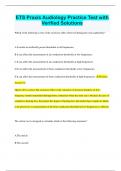
ETS Praxis Audiology Practice Test with Verified Solutions Which of the following is true of the occlusion effect observed during pure tone audiometry? A.It results in artificially poorer thresholds at all frequencies. B.It can affect the measurement of air-conduction thresholds at low frequencies. C.It can affect the measurement of air-conduction thresholds at high frequencies. D.It can affect the measurement of bone-conduction thresholds at low frequencies. E.It can affect the measurement of bone-conduction thresholds at high frequencies. Correct Answer: D Option (D) is correct.The occlusion effect is the sensation of increased loudness of low- frequency sounds transmitted through bone conduction when the outer ear is blocked. In cases of conductive hearing loss, the greater the degree of hearing loss, the louder these sounds are likely to be perceived, so measurement of the bone-conduction threshold at low frequencies is affected The caloric test is designed to stimulate which of the following structures? A.The utricle B.The saccule C.The superior semicircular canal D.The posterior semicircular canal E.The lateral semicircular canal Correct Answer: E Option (E) is correct. The caloric test introduces a temperature differential that is designed to cause the fluid in the semicircular canal closest to the stimulus to move. The lateral semicircular canal is closest to the tympanic membrane, where the stimulus is introduced. An audiologist fit a young woman with binaural digital behind-the-ear hearing aids three weeks ago. The patient reports that the devices have provided suitable amplification in most environments, but she complains that low-level ambient noise has been distracting. In an effort to reduce the adverse noise effect, what adjustment might the audiologist make to the hearing aids? A.Increasing the threshold kneepoint B.Decreasing the threshold kneepoint C.Enabling wide dynamic range compression D.Decreasing the gain in all frequency bands E.Enabling expansion Correct Answer: E Option (E) is correct. Expansion reduces the gain of low-level ambient sounds. Individuals with normal hearing sensitivity in one ear and a severe hearing loss in the other ear experience which of the following? A.An improvement in speech understanding when the noise is closer to the ear with hearing loss B.Improved ability to localize when the noise source is closer to the ear with normal hearing C.Better speech understanding and localization as the reverberation time increases D.More difficulty understanding speech when the speaker moves closer to the ear with hearing loss E.Improved localization when the noise is at 0° azimuth and the source is closer to the ear with hearing loss Correct Answer: A Option (A) is correct. It is well-known that for individuals with unilateral hearing loss, speech intelligibility improves when the more favorably placed ear (i.e., the better ear) is further from the noise source. When this occurs then the SNR improves in the better ear. A patient is seen for a vestibular evaluation with the primary complaint of persistent imbalance for the past six months. She states that she had one severe attack of true rotary vertigo six months ago, and since then fears another will occur. She has limited her activities, as quick head movements increase her symptoms. She reportedly takes meclizine daily. Videonystagmography results indicate normal saccade, optokinetic, and smooth pursuit testing. A second-degree left-beating nystagmus is observed during gaze testing without fixation. Postactive head-shake nystagmus reveals a left-beating nystagmus. No positioning or positional nystagmus is observed. Bilateral bithermal caloric results indicate a 50 percent right weakness with no significant directional preponderance. Based on the above information, the patient most likely has A.Ménière's disease B.a central vestibular pathology C.a statically uncompensated p Correct Answer: E Option (E) is correct. Videonystagmography results normally provide site-of-lesion specific information (i.e., caloric irrigations) to determine probable side of weakness. In this example, the patient had a 50 percent right peripheral vestibular weakness, suggesting a peripheral pathology affecting the right side. The postactive head-shake left-beating nystagmus suggests that the lesion is dynamically uncompensated. Which of the following is a possible outcome of an audiologist using a physician's NPI for billing rather than using his or her own NPI?
Written for
- Institution
- ETS Praxis Audiology
- Course
- ETS Praxis Audiology
Document information
- Uploaded on
- May 10, 2024
- Number of pages
- 82
- Written in
- 2023/2024
- Type
- Exam (elaborations)
- Contains
- Questions & answers
Subjects
-
ets praxis audiology practice test with verified

Also available in package deal