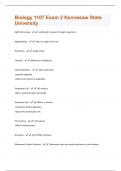
Biology 1107 Exam 2 Kennesaw State University Questions And Answers With Verified Solutions
Light Microscope - -visible light is passed through a specimen Magnification - -ratio of image to real size Resolution - -image clarity Contrast - -difference in brightness Cell fractionation - -Takes cells apart -separate organelle -Determine function of organelles Prokaryotic Cell - -NO nucleus -DNA is unbound region (nucleoid) Eukaryotic cells - -DNA is in nucleus -membrane bound organelles -larger then prokaryotic cells The Nucleus - -Cell's genes -DNA in chromosomes Nucleolus - -Site of RNA synthesis Ribosomes: Protein Factories - -Ribosomes carry out protein synthesis in two locations-ER and nuclear envelope Endomembrane System Consists of: - o Nuclear envelope o Endoplasmic reticulum o Golgi apparatus o Lysosomes o Vacuoles o Plasma membrane Smooth ER - -Lacks ribosomes -Synthesizes and Detoxifies Rough ER - -Contains ribosomes -Glycoproteins -Transport Vesicles Golgi Apparatus - o Modifies products of the ER o Manufactures certain macromolecules o Sorts and packages materials into transport vesicles Lysosomes - -Digestive Compartment -recycles cells own organelles Phagocytosis - -Cell eating Vacuoles - -Maintenance for cells -Derived from ER and Golgi ApparatusMitochondria - -cell respiration uses ATP Chloroplasts - -Found in plants -photosynthesis Mitochondria: Chemical Energy Conversion - -Mitochondria are in nearly all eukaryotic cells -They have a smooth outer membrane and an inner membrane folded into cristae -The inner membrane creates two compartments: intermembrane space and mitochondrial matrix Chloroplasts: Capture of Light Energy - -Chloroplasts contain the green pigment chlorophyll, as well as enzymes and other molecules that function in photosynthesis -Chloroplasts are found in leaves and other green organs of plants and in algae Peroxisomes: Oxidation - -Peroxisomes produce hydrogen peroxide and convert it to water Cytoskeleton - -The cytoskeleton helps to support the cell and maintain its shape -It interacts with motor proteins to produce motility -Inside the cell, vesicles can travel along tracks provided by the cytoskeleton Centrosome - -Microtubules near nucleus Centrioles - -each with nine triplets of microtubules arranged in a ring Cilia and flagella - o A core of microtubules sheathed by the plasma membrane o A basal body that anchors the cilium or flagellum o A motor protein called dynein, which drives the bending movements of a cilium or flagellum Microfilaments - -Microfilaments are solid rods built as a twisted double chain of actin subunits-Microfilaments that function in cellular motility contain the protein myosin in addition to actin Chloroplast Movement - -Cytoplasmic streaming is a circular flow of cytoplasm within cells Intermediate Filaments - -They support cell shape and fix organelles in place Extracellular Matrix (ECM) of Animal Cells - -Animal cells lack cell walls but are covered by an elaborate extracellular matrix (ECM) -The ECM is made up of glycoproteins such as collagen, proteoglycans, and fibronectin -ECM proteins bind to receptor proteins in the plasma membrane called integrins Cell Junctions - -Neighboring cells in tissues, organs, or organ systems often adhere, interact, and communicate through direct physical contact Tight junctions - -membranes of neighboring cells are pressed together, preventing leakage of extracellular fluid Desmosomes - -fasten cells together into strong sheets Gap junctions - -(communicating junctions) provide cytoplasmic channels between adjacent cells Cellular membranes - • Phospholipids are the most abundant lipid in the plasma membrane • Phospholipids are amphipathic molecules, containing hydrophobic and hydrophilic regions • A phospholipid bilayer can exist as a stable boundary between two aqueous compartments
Written for
- Institution
- Biology 1107 Kennesaw State University
- Course
- Biology 1107 Kennesaw State University
Document information
- Uploaded on
- May 10, 2024
- Number of pages
- 16
- Written in
- 2023/2024
- Type
- Exam (elaborations)
- Contains
- Questions & answers
Subjects
-
biology 1107 kennesaw state university

Also available in package deal