USA EIP Final Review latest questions and answers all are correct 2024 graded A+
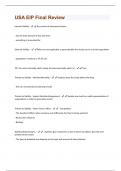
Internal Validity - the control of extraneous factors - has the least amount of bias and error - everything is accounted for External Validity - Refers to how applicable or generalizable the results are to a certain population - population= stroke pt's, PT, OT, etc. T/F: the more internally valid a study, the least externally valid it is - True Threats to Validity - Attrition/Mortality - Subjects leave the study before finishing - this can increase bias by skewing results Threats to Validity - Subject Selection/Assignment - Sample size must be a valid representation of a population in order to generalize results Threats to Validity - Other Forms of Bias - - Competition - The Hawthorn Effect: when someone acts differently b/c they're being watched - Researcher Influence - Binding Statistics/Data Analysis - - Statistics give researchers a tool in which to explain, describe and predict future results - The type of statistical test depends on the type and amount of data collectedCommonly Used Descriptive Statistics - 1. T-Test 2. ANOVA 3. Regression T-Test - Compares a mean value to either a theoretical mean or another mean ANOVA (Analysis of Variance) - Compares groups to each other - it is trying to see how far the data skews away from the mean - used with more than 2 groups Regression - Measures how the independent variable effects the dependent variable at several points Statistical Significance - A statistical statement of how likely it is that an obtained result occurred by chance "P-Value" Confidence Interval - A range of values so defined that there is a specified probability that the value of a parameter lies within it. Independent Variable - The variable that is CHANGED or controlled in a scientific experiment to test the effects on the dependent variable Dependent Variable - The variable being tested and measured in an experiment; the RESPONSE is being measured Experimental Method Discussion - 1. Participants 2. Materials3. Procedures 4. Measures Quasi-Experiment: - When participants are not randomly assigned to groups Threats to Internal Validity - 1. History 2. Maturation 3. Regression 4. Selection 5. Mortality 6. Diffusion of Treatment 7. Compensatory or Rivalry 8. Testing 9. Intrumentation Threats to External Validity - 1. Interaction of Selection and Treatment 2. Interaction of Setting and Treatment 3. Interaction of History and Treatment What makes up a good question? - 1. Background --> overview/broad 2. Foreground --> specific 3. Equipoise --> equal view about a topic; minimized bias 4. Directional or Non-Directional --> deals with hypothesis but ends up being biased (directional); depends on how it is worded What does PICO stand for? - P- Patient Population I - Intervention C - Comparison O - OutcomeFirst Step of a Research Project - The goal is to explain and predict - ultimate goal is to answer a question - the question can be answered in many ways (ie. survey, randomized control trial, case-control study) Questions to Ask When Critiquing a Research Study - 1. Is the study REPRODUCIBLE? 2. Are the instruments VALIDATED? 3. How were the subjects chosen? 4. How were the subjected assigned to groups? 5. How was data collected? 6. How was the data interpreted? Survey - Is a study that essentially asks people questions that either generalize or explain trends in behavior, beliefs, ect. Experiment - Aims to test an intervention to measure its impact - an experiment needs to control ALL variables except for the one its intending to measure Random Sampling - Subjects are randomly chosen from a list of potential subjects Convenience Sample - Subjects are chosen out of a list of potential subjects based on availability Random Assignment - Occurs when subjects are randomly assigned to a specific group - this reduces biasInstrumentation - - The instrument used in the study needs to have detailed information given about its usage and validity - An instrument could be a survey, a tool, a piece of equipment, etc - The instrument needs to be proven to work and proven to measure what it's supposed to measure Validity - the extent to which a test measures or predicts what it is supposed to - needs to be proven Reliability - Ability of a test to yield very similar scores for the same individual over repeated testings - needs CONSISTENCY Types of Scholarly Publications - 1. Books 2. Non-Peer Reviewed Journals an Professional Magazines 3. Peer Reviewed Journals 4. Electronic Bibliographic Databases and the Internet Peer Reviewed Journals - Short Reports - Tend to describe new of developing programs, projects, or treatment techniques Peer Reviewed Journals - Editorials - - They raise important issues in the field, offer perspectives on controversial subjects, etc. - Are invited papers written by experts in the field Peer Reviewed Journals - Systematic Reviews - Full length articles that can be critical reviews of literature or meta-analyses of existing researchPeer Reviewed Journals - Book and Technology Reviews - Are usually invited critiques of new resources available Peer Reviewed Journals - Research Articles - These provide information on the newest scientific findings and advances in a particular area Checklist of Questions to Ask Yourself to Evaluate a Web Page - 1. Authority --> Who runs this site? 2. Accuracy --> Sources of info & where it's from? 3. Objectivity --> Is there a presence of bias? 4. Currency --> How old is this info? 5. Scope, Coverage, Relevance 6. Commercialism --> What's the cost? What is qualitative research? - A systematic, subjective approach to research that is used to describe life experiences and situations and give them meaning. - open ended questions - occurs in Naturalistic Settings - researcher as the instrument --> observer or participant - Emergent Design - multiple sources of data --> looking for "triangulation" to see if they lead to the same result to confirm - participant's meaning - Reflexivity --> must be aware of their own bias - Holistic Accoun
Written for
- Institution
- USA EIP
- Course
- USA EIP
Document information
- Uploaded on
- May 10, 2024
- Number of pages
- 13
- Written in
- 2023/2024
- Type
- Exam (elaborations)
- Contains
- Questions & answers
Subjects

Also available in package deal