UMICH CHEM 210 - Exam #3 - Reaction Mechanisms 100% Correct.
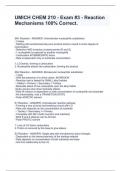
SN1 Reaction - ANSWER- Unimolecular nucleophilic substitution - 2 steps - Starting with enantiomerically pure product tends to result in some degree of racemization - Retention AND inversion at stereocenter (R and S) - 1 nucleophile is replaced by another nucleophile - Carbocation INTERMEDIATE forms - Rate is dependent only on substrate concentration 1. LG leaves, forming a carbocation 2. Nucleophile attacks the carbocation, forming the product SN2 Reaction - ANSWER- Bimolecular nucleophilic substitution - 1 step - With the presence of a chiral center, INVERSION - Reaction rate is fastest for SMALL alkyl halides ~ Methyl > Primary > Secondary > Tertiary - Backside attack of the nucleophile upon the alkyl halide (bulky groups slow down backside attack) - Rate of reaction is dependent on both concentration of nucleophile and substrate - No intermediate, only a TRANSITION STATE - Polar APROTIC solvent E1 Reaction - ANSWER- Unimolecular reaction pathway - Forming a new pi bond and breaking a bond with LG - Rate only depends on the concentration of substrate ~ Tertiary > Secondary >> Primary - Competes with SN1 (both inversion and retention) - Both E and Z alkenes can be formed - Polar PROTIC solvent 1. Loss of LG forms carbocation 2. Proton is removed by the base to give alkene E2 Reaction - ANSWER- Single step with simultaneous bond changes - Dependent on the stereochemistry of the starting material - Rate depends on concentration of both substrate and base - Anti ß-H relationship to the LG - Polar
Written for
- Institution
- UMICH CHEM 210
- Course
- UMICH CHEM 210
Document information
- Uploaded on
- May 9, 2024
- Number of pages
- 3
- Written in
- 2023/2024
- Type
- Exam (elaborations)
- Contains
- Questions & answers
Subjects
-
umich chem 210 exam 3 reaction mechanisms 100
-
umich chem 210 exam 3 stuvia

Also available in package deal