PHARMACOLOGY IN PT STUDY GUIDE
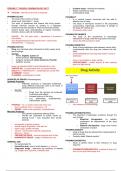
RELIMS 1ST LESSON: PHARMACOLOGY IN PT Penicillin - take 48 hrs for fever to dissipate PHARMACOLOGY • The study of the science of drugs • Greek word “pharmakon” = drugs • The study of substances that interact with living system through chemical process by binding to a regulatory molecules that may activate or inhibit normal body process • Science based upon understanding of organic chemistry, biochem, physio, patho & microbiology • NSAIDS - RA, OA (pain killer) - nephrotoxic if excessive = renal failure • Any dosage that beyond therapeutic level = cause harm • PROTOTYPE - 1st medicine PHARMACEUTICS • Drug: any chemicals when introduced to body causes some sort of change • Sources: o Plants: Digitalis, Castor oil o Animal products: Thyroid drugs o Inorganic compounds: Gold, Aluminum, Fluoride o Synthetic sources • drugs has intended effect to body (therapeutic or non) • CASTOR OIL - to clean bowel of pt; very good laxative • GOLD AS A THERAPEUTIC - crisotherapy (for pt with RA) • ALUMINUM - Antacid • FLUORIDE - enamelization of teeth SOURCES OF DRUGS: Pharmacognosy Synthetic Products: o Artificially produced or duplicated substances using different compounds used to be found in plants/animals/environment • Benefits: ▪ Drugs from the sources are produced to eliminate side effects ▪ Increase potency of the drug ▪ (i.e.) barbiturates, amphetamines, sulfonamides, aspirin • POTENCY - inc, no need to take med every hour • due to synthetic med = inc potency = od • SHABU - made in lab (synthetic), Amphetamines Microbial Products: o Thru genetic engineering (altering DNA) o Permits the production of human insulin by altering E.coli = less impurities than animal products • prerequisite of genetic engring • central dogma of genetics - dna and rna • higher sugar, greater mortality • Vaccine - direct result of genetic engineering • Best e.g. = insulin • PREVENTIVE DRUG - vaccines (prevent devt of dse) • DIAGNOSTIC DRUGS - antigen, antibody test, dye GENERAL USE • For symptomatic Rx • Preventive drug - use to avoid disease e.g. vaccine • Diagnostic drugs - determine the presence of disease e.g. antigen test, rapid test, antibodies test • Curative drugs - eliminate the disease • Health maintenance drugs • Contraceptive drugs PHARMACY • Is a medical science concerned with the safe & effective use of meds • The study of techniques involved in the preparation, compounding, dispensing, preservation & storage of the drugs for medical use. • therapeutic action need PHARMACODYNAMICS • The study of the biochemical & physiologic interactions of drugs; what the drug does to the body • what is the effect of blood in body PHARMACOKINETICS • Study of drug distribution rates between various body compartments after the drug has entered into the body • kinetics(distribution) how drug when taken in body is distributed • know is lipid-soluble or water-soluble • LIPID-SOLUBLE - limited amount & more spacing due to its high toxicity • core essence of pharmacology PHARMACOTHERAPEUTICS • The treatment of pathologic conditions through the use of drugs o Empirical therapeutics: no suitable explanation for effectiveness of the drug involved o Rational therapeutics: drugs have known mechanism of action PHARMACOGNOSY • study of drugs that are obtained from natural plants & animal sources • Formally called “Materia medica” PHARMACOGENETICS • Study of genetic factor & their influence on drug response • PHARMACOTHERAPEUTICS - purpose of drug in pt; why do you give these drugs to pt • give drug that has broader effect, to lessen • RATIONAL THERAPEUTICS - know mechanism of action, know its intended effect • PHARMACOGNOSY - drugs from plants and animal, herbal medicine • PHARMACOGENETICS - g6pd: cause hemolysis of blood, do not give chlomorokin … TOXICOLOGY • Study of poisonous effects of drugs • Antidotes • what would revert action of drugs • (I.E.) uminom ng baygon or muriatic acid(deadly) - revert this action organophosphate MECHANISM OF ACTION • Pharmacodynamics • Indication: o The use of that drug for treating a particular disease o (i.e.) Diabetes is an indication for insulin. o Insulin is indicated for the treatment of diabetes • Side effect o All drugs have the potential to affect more than 1 body system simultaneously • Adverse effect o Undesired effects that may be unpleasant or even dangerous o May occur as: ▪ may have other effects on the body besides the therapeutic effect ▪ Pt is sensitive to the drug given ▪ Drug’s action on the body causes other responses that are undesirable/unpleasant ▪ Pt is taking too much/too little of the drug • BRONCHODLATORS - intended effect = open airways; bad effect = inc hr or palpitations, tremors • SIDE EFFECT - expected effect on the other organ system affect and not the target organ • IBUPROFEN - adverse effect = urticaria • unexpected & harmful reaction from drug FORMS OF DRUGS I. Solid • Tablet: the most popular dosage form, easiest to administer • Timed or sustained release tablet: drugs is released in a controlled fashion o Contains K chloride, or built with osmotic pumps, or layers • Capsules: drug is enclosed in a hard or soft soluble shell • Troches or lozenges: should be dissolved slowly in mouth • Suppositories: dosage form usually inserted into one of external orifice • SUSTAINED RELEASE TABLET - slowly degraded/digestion by git, but longer therapeutic effect • METROMINE XR - sustained release • !!!! DO NOT CRUSH SUSTAINED RELEASE TABLET (for dm) • LOZENGES - anything you place in your and slowly dissolve (let it dissolve) • NURSE - know the root of administration of drug II. Liquid • Syrups: sweetened solutions to mask the unpleasant taste of certain drugs • Tincture: solutions that contain alcohol as primary solvent • Douche: a solution is one used in cleansing a body part or cavit • Suspensions: liquid dosage forms that contain solid drug particles suspended in a suitanle liquid medium • Emulsions: dispersions of fine droplets of an oil in water or water in oil • TINCTURE - Antiseptics • DOUCHE - ph care, lactacyd • SUSPENSIONS - solid initially, instill water = liquid • ELIXIR - sweet solution but taste alcohol (Robitosin) DRUG ABSORPTION (exam sensitive) 1. Liquid, elixirs, syrups (fastest) 2. Suspension solutions 3. Powders 4. Capsules 5. Tablets 6. Coated tablets 7. Enteric coated (slowest) III. Topical • Ointments: insoluble in water • Creams: soluble in water • Patches: skin to blood absorption • Aerosols/Inhalers IV. Parenteral • Ampules: sterile, sealed glass or plastic container with single liquid dose • Vials: single or multiple dose glass that are sealed with rubber diaphragm • OINTMENT - insoluble in water • CREAM - Soluble in water • PATCHES - Nitroglycerine, salonpas • AMPULES - in a glass • VIALS - With cover CHEMICAL NAME • Any typical organic chemical name • 4-thia-1 azabicyclo ([3.2.0]heptane-2-carboxylic acid, 6 [aminophenylacetyl]am
Document information
- Uploaded on
- May 9, 2024
- Number of pages
- 80
- Written in
- 2023/2024
- Type
- Exam (elaborations)
- Contains
- Questions & answers