
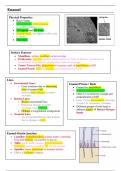
Enamel
Physical Properties
• Hard / brittle
• 96% inorganic hydroxyapatite
(Ca10(PO4)6(OH)2)
• 1% organic and 3% water
• Grayish-white, but appears yellow due
to dentin
• 2mm thick
Surface Features
• Mamillons: surface swellings on incisal edge
• Perikymata: grooves (external manifestations of striae of Retzius), prominent on
cervical and facial regions, produced by ends of rod groups
• Tomes’ Process Pits: projections of secretory ends of ameloblasts at EDJ
• Enamel Pearls: hills and troughs on cervical region of tooth
Lines
• Incremental Lines: Enamel Prisms / Rods
o Cross striations due to alternating • Formed by ameloblasts
sizes of enamel rods • 4-7um diameter, 9um long
o Indicate daily changes in matrix
• Outer 1/3 is relatively straight and
secretion
perpendicular to EDJ
• Retzius Lines:
• Inner 1/3 has decussations (crossing
o Brown incremental lines
of rods) → ‘horseshoe’ boundary
o Represent changes in matrix
• Different groups of rods bend at
secretion every 7-9 days
different angles → Hunter-Shreger
o Oblique to longitudinal arrangement
bands
• Neonatal Line:
o An accentuated Retzius line formed
due to changes at birth
Enamel-Dentin Junction
• Lamellae: hypomineralised enamel matrix extending
from EDJ linearly (susceptible to decay)
• Tufts: small, darkly stained, hypomineralised,
branching defects extending 1/3 into the enamel
• Spindles: linear extensions of dentinal tubules
• EDJ is a scalloped complex
, Dentin
Dentin Classification
• Primary: mantle + circumpulpal dentin
• Secondary: forms after tooth eruption,
deposited more slowly than primary
• Tertiary: forms in response to trauma
• Predentin: newly formed, unmineralized
matrix of dentin at pulpal border
• Mantle Dentin: just below the EDJ, 150um
thick, composed of large collagen fibres,
less mineralised
• Circumpulpal Dentin: bulk of dentin
below mantle, 6-8mm thick
• Coronal Dentin = crown dentin
• Reticular Dentin = root dentin
Tertiary Dentin
• Fairly irregular in structure
• Reactionary: mild irritation → upregulation of growth factors → mineralisation
• Reparative: strong irritation → odontoblast death → pre-odontoblast differentiation →
upregulation of growth factors → mineralisation
Dentinal Tubules
• Microscopic canals in dentin
• Contains odontoblast processes
• Peritibular Dentin: hyperminalised collar
around dentin tubules
• Intertubular Dentin: main body of dentin
between dentin tubules
Lines Physical Properties
• Von Ebner’s Lines: light-dark paired • Yellowish, resilient, brittle
bands that form due to circadian • 70% mass and 50% volume inorganic
variation in acid-base balance (hydroxyapatite)
• Andresen Lines: long period variation, • 20% mass and 30% volume organic
visibility enhanced by polarised light (collagen fibre)
• Neonatal Line: accentuated contour line • 10% mass and 20% volume water
• Granular Layer of Tomes: hypomineralised area at periphery of root
• Hyaline Layer of Hopewell Smith: thin, clear, structureless layer between granular layer of
Tomes and primary cementum
Physical Properties
• Hard / brittle
• 96% inorganic hydroxyapatite
(Ca10(PO4)6(OH)2)
• 1% organic and 3% water
• Grayish-white, but appears yellow due
to dentin
• 2mm thick
Surface Features
• Mamillons: surface swellings on incisal edge
• Perikymata: grooves (external manifestations of striae of Retzius), prominent on
cervical and facial regions, produced by ends of rod groups
• Tomes’ Process Pits: projections of secretory ends of ameloblasts at EDJ
• Enamel Pearls: hills and troughs on cervical region of tooth
Lines
• Incremental Lines: Enamel Prisms / Rods
o Cross striations due to alternating • Formed by ameloblasts
sizes of enamel rods • 4-7um diameter, 9um long
o Indicate daily changes in matrix
• Outer 1/3 is relatively straight and
secretion
perpendicular to EDJ
• Retzius Lines:
• Inner 1/3 has decussations (crossing
o Brown incremental lines
of rods) → ‘horseshoe’ boundary
o Represent changes in matrix
• Different groups of rods bend at
secretion every 7-9 days
different angles → Hunter-Shreger
o Oblique to longitudinal arrangement
bands
• Neonatal Line:
o An accentuated Retzius line formed
due to changes at birth
Enamel-Dentin Junction
• Lamellae: hypomineralised enamel matrix extending
from EDJ linearly (susceptible to decay)
• Tufts: small, darkly stained, hypomineralised,
branching defects extending 1/3 into the enamel
• Spindles: linear extensions of dentinal tubules
• EDJ is a scalloped complex
, Dentin
Dentin Classification
• Primary: mantle + circumpulpal dentin
• Secondary: forms after tooth eruption,
deposited more slowly than primary
• Tertiary: forms in response to trauma
• Predentin: newly formed, unmineralized
matrix of dentin at pulpal border
• Mantle Dentin: just below the EDJ, 150um
thick, composed of large collagen fibres,
less mineralised
• Circumpulpal Dentin: bulk of dentin
below mantle, 6-8mm thick
• Coronal Dentin = crown dentin
• Reticular Dentin = root dentin
Tertiary Dentin
• Fairly irregular in structure
• Reactionary: mild irritation → upregulation of growth factors → mineralisation
• Reparative: strong irritation → odontoblast death → pre-odontoblast differentiation →
upregulation of growth factors → mineralisation
Dentinal Tubules
• Microscopic canals in dentin
• Contains odontoblast processes
• Peritibular Dentin: hyperminalised collar
around dentin tubules
• Intertubular Dentin: main body of dentin
between dentin tubules
Lines Physical Properties
• Von Ebner’s Lines: light-dark paired • Yellowish, resilient, brittle
bands that form due to circadian • 70% mass and 50% volume inorganic
variation in acid-base balance (hydroxyapatite)
• Andresen Lines: long period variation, • 20% mass and 30% volume organic
visibility enhanced by polarised light (collagen fibre)
• Neonatal Line: accentuated contour line • 10% mass and 20% volume water
• Granular Layer of Tomes: hypomineralised area at periphery of root
• Hyaline Layer of Hopewell Smith: thin, clear, structureless layer between granular layer of
Tomes and primary cementum


