Exam #3 Bio 235 Athabasca Questions and Answers 100% Pass
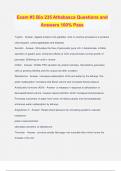
Exam #3 Bio 235 Athabasca Questions and Answers 100% Pass Trypsin - Answer- digests proteins into peptides. Acts on inactive processors to produce chymotrypsin, carboxypeptidase and elastase Secretin - Answer- Stimulates the flow of pancreatic juice rich in bicarbonate. inhibits secretion of gastric juice, enhances effects of CCK and promotes normal growth of pancreas. Buffering ion acid in chyme Inhibin - Answer- Inhibits FSH secretion by anterior pituitary. Secreted by granulose cells of growing follicles and the corpus lute after ovulation Aldosterone - Answer- increases reabsorption of Na and water by the kidneys. this water reabsorption increases total blood volume and increases blood pressure Antidiuretic hormone (ADH) - Answer- is releases in response to dehydration or decreased blood volume. Causes vasoconstriction which increases blood pressure. Promotes movement of water from lumen of kidney tubules into the bloodstream enhances water reabsorption by kidneys Angiotensin II - Answer- Raises blood pressure by increasing systemic vascular resistance potent vasoconstricter stimulates secretion of aldosterone Thrombin - Answer- converts soluble fibrinogen into insoluble fibrin which forms the threads of the clot Lingual Lipase - Answer- acts on as much as 30% of the dietary triglycerides and converts them to simpler fatty acids and diglycerides. Becomes activated in the acidic environment of the stomach thus starts working after food has been swallowed Salivary Amylase - Answer- A digestive enzyme that acts on starch activated by chloride ions in saliva breaks start down into maltose, maltatroise and a-dextrin continues to break down food after it has been swallowed for about an hour Basophil - Answer- release granules that contain heparin, histamine and serotonin which all intensify inflammatory reactions and are involved in allergic reactions similar function as mast cells .5-1% of all WBC Neutrophils - Answer- release several chemicals to destroy a pathogen contain defensins which poke holes in microbe membranes Participate in destruction of bacteria Phagocytosis 60-70% of all WBC Monocyte - Answer- Arrive in larger numbers and destroy more microbes. Once arriving they enlarge and differentiate into wandering macrophages, which clean up cellular debris and microbes by phagocytosis after an infection 3-8% of all WBC Eosinophil - Answer- Believed to release enzymes such as histaminase that combat the effects of histamine and other substances involved in inflammation during allergic reactions phagocytize antigen-antibody complexes and are effective against parasitic worms 2-4% of all WBC Plasma proteins - Answer- Albumins
Written for
- Institution
- BIOL 235
- Course
- BIOL 235
Document information
- Uploaded on
- May 8, 2024
- Number of pages
- 18
- Written in
- 2023/2024
- Type
- Exam (elaborations)
- Contains
- Questions & answers
Subjects
-
exam 3 bio 235 athabasca questions and answers 10

Also available in package deal