

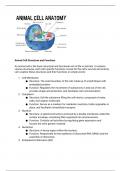
Animal Cell Structures and Functions
An animal cell is the basic structural and functional unit of life in animals. It contains
various structures, each with specific functions crucial for the cell's survival and activity.
Let's explore these structures and their functions in simple words:
1. Cell Membrane:
● Structure: The outer boundary of the cell, made up of a lipid bilayer with
embedded proteins.
● Function: Regulates the movement of substances in and out of the cell,
provides shape and protection, and facilitates cell communication.
2. Cytoplasm:
● Structure: Gel-like substance filling the cell interior, composed of water,
salts, and organic molecules.
● Function: Serves as a medium for metabolic reactions, holds organelles in
place, and facilitates intracellular transport.
3. Nucleus:
● Structure: A spherical structure enclosed by a double membrane called the
nuclear envelope, containing DNA organized into chromosomes.
● Function: Controls cell activities by regulating gene expression and
houses the cell's genetic material.
4. Nucleolus:
● Structure: A dense region within the nucleus.
● Function: Responsible for the synthesis of ribosomal RNA (rRNA) and the
assembly of ribosomes.
5. Endoplasmic Reticulum (ER):
An animal cell is the basic structural and functional unit of life in animals. It contains
various structures, each with specific functions crucial for the cell's survival and activity.
Let's explore these structures and their functions in simple words:
1. Cell Membrane:
● Structure: The outer boundary of the cell, made up of a lipid bilayer with
embedded proteins.
● Function: Regulates the movement of substances in and out of the cell,
provides shape and protection, and facilitates cell communication.
2. Cytoplasm:
● Structure: Gel-like substance filling the cell interior, composed of water,
salts, and organic molecules.
● Function: Serves as a medium for metabolic reactions, holds organelles in
place, and facilitates intracellular transport.
3. Nucleus:
● Structure: A spherical structure enclosed by a double membrane called the
nuclear envelope, containing DNA organized into chromosomes.
● Function: Controls cell activities by regulating gene expression and
houses the cell's genetic material.
4. Nucleolus:
● Structure: A dense region within the nucleus.
● Function: Responsible for the synthesis of ribosomal RNA (rRNA) and the
assembly of ribosomes.
5. Endoplasmic Reticulum (ER):


