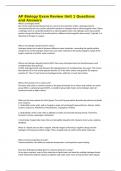
AP Biology Exam Review Unit 1 Questions and Answers
AP Biology Exam Review Unit 1 Questions and Answers What is a hydrogen bond? One of the weak chemical bonds that are central to the chemistry of life; a hydrogen bond is characterized by the non-covalent attraction between a hydrogen and an electronegative atom. When a hydrogen atom is covalently bonded to an electronegative atom, the hydrogen atom has a partial positive charge that allows it to be attracted to a different electronegative atom nearby. Typically, it is attracted to nitrogen or oxygen. Where are hydrogen bonds found in water? Hydrogen bonds are located in between different water molecules, connecting the partial positive charge of one of the hydrogen atoms from one water molecule to the partial negative charge of the oxygen molecule of another water molecule. Where are hydrogen bounds found in DNA? How many hydrogen bonds are found between each complementary base pairing? In DNA, hydrogen bonds exist between the opposing bases of complementary base pairs. This means that adenine (A) in one strand opposes thymine (T) in the other strand, and guanine (G) opposes cytosine (C). The A-T pair forms two hydrogen bonds, while the C-G pair forms three. What is the structure of an amino acid? All amino acids share a common structure; the general formula for an amino acid contains an amino group (NH2), a carboxyl group (COOH), a variable R group (side chain), and a hydrogen atom all centered around an alpha carbon. What are the three options for the R group? For each R group option, describe the polarity and justify your response. 1. Hydrophilic amino acids, with a charged or polar and uncharged R group (Glycine, Alanine, Valine, Leucine, Isoleucine, Methionine, Phenylalanine, Tryptophan, Proline) 2. Hydrophobic amino acids, with an aliphatic or bulky and aromatic R group (Serine, Threonine, Cysteine, Tyrosine, Asparagine, Glutamine) 3. Electrically charged side chains that are hydrophilic (Aspartic Acid, Glutamic Acid, Lysine, Arginine, Histidine) Water is a dipole and acts like a magnet, with the oxygen end having a negative charge and the hydrogen end having a positive charge. These charged ends can attract other polar molecules. What are three properties of water? Cohesive behavior, the ability to moderate temperature, and expansion upon freezing. How does hydrogen bonding allow for cohesive behavior in water?
Written for
- Institution
- AP Biology
- Course
- AP Biology
Document information
- Uploaded on
- May 7, 2024
- Number of pages
- 8
- Written in
- 2023/2024
- Type
- Exam (elaborations)
- Contains
- Questions & answers
Subjects
-
ap biology exam review unit 1 questions and answer

Also available in package deal