aqa a level psychology - year 1 Exam Questions and Answers 100% Pass
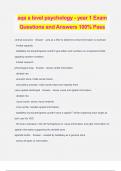
aqa a level psychology - year 1 Exam Questions and Answers 100% Pass central executive - Answer-- acts as a filter to determine what information is received - limited capacity - baddeley found participants couldn't type letters and numbers on a keyboard whilst speaking random numbers - limited research phonological loop - Answer-- stores verbal information - divided into: - acoustic store: holds words heard - articulatory process: holds words heard and repeats them visuo-spatial sketchpad - Answer-- stores visual and spatial information - divided into: - visual cache: stores visual material - inner scribe: handles spatial information - baddeley found participants couldn't trace a capital F whilst explaining each angle as both use the VSS - the brain activates in the left hemisphere for visual information and right information for spatial information supporting the divided store episodic buffer - Answer-- created by baddeley as a general store - stores all types of information - limited capacity - a case study shows a person held 25 items in their STM which is more than the capacity of the VSS and PL suggesting a third store - very limited research to support this being here interference theory example and evaluation - Answer-information in the LTM gets disrupted with other information during coding which leads to inaccurate recall. 1. proactive interference: occurs when something previously-stored interferes an attempt to recall something new e.g. trying to recall a new phone number but getting confused with the old one 2. retroactive interference: occurs when newly stored information interferes with the recall of previously stored information e.g. trying to recall your new number plate but getting confused with the old one baddeley and hitch got rugby players to recall all the teams they have played against to test interference theory and trace decay. they found forgetting was more due to the number of games played rather than the time between each game supporting interference theory rather than decay theory only explains forgetting when two sets of information are similar -> lacks mundane realism cue dependent forgetting example and evaluation - Answer-- information is in the LTM but cannot be accessed - see's recall as dependent on retrieval cues - the effectiveness depends on how overloaded the cue is, if there isn't much information, recall will be easier - the effectiveness also depends on how deep the processing is, the more meaningful it is, the easier recall 1. context dependent forgetting forgetting occurs when the external environment is different in recall than it was in coding 2. state dependent forgetting forgetting occurs when the internal environment is different at recall than it is at coding overton found recall was worse when the internal state was different at recall than it was at coding, suggesting state-dependent forgetting is a valid explanation - most studies are lab based so reliability is decreased - supports the theory that deeper processed memories are easier to recall - a lot of evidence support repression example and evaluation - Answer-- motivated forgetting where emotionally threatening events are pushed to the unconscious to prevent anxiety - the effect of the memories are still there but it is harder to recall the memory itself - some don't believe it as repressed thought therapy has often proved to be false (false memory syndrome) - williams found 38% of women who suffered sexual assaults in childhood had no recollection of the memory whatsoever. he
Written for
- Institution
- AQA A-Level Psychology
- Course
- AQA A-Level Psychology
Document information
- Uploaded on
- May 7, 2024
- Number of pages
- 18
- Written in
- 2023/2024
- Type
- Exam (elaborations)
- Contains
- Questions & answers
Subjects
-
aqa a level psychology year 1 exam questions and

Also available in package deal