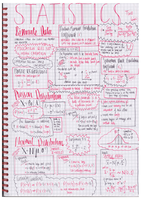
Explicit solution:y f(x =
3 Notations: DEs have
1.1-Basic ideas functions
Implicitsolution:facys=0 a 3 2y 0 Lebonitz solutions
+ +
=
as
Prove fees is
Order DE G 0
y' 3y" 2g Newton
a
sol.
DECODE) of to
:Ordinary Partial
a
2. DECPDE)
+ + =
DE:plug it
xy-(y')
4
0
=
into the DE
I 3(9) y +
=
64 +
6y bxy
=
·
-
3rd order
Highest
order
③
i 3i 2y
+ + 0
= Prime
of derivative
de +
=
3yx
Separable equations 1.2 -
Initial Value Problem (IVP):
① find solution to the IVP
Separable DE: Steps to solve separable equations
a g(x)f(y) G f(y) ② to each
g(x) ① Get do with
dy with
y
oR sc,
② Sub
fecc,y)
= -
in
points to or
I side
fx,y,z) ③ of
Integrate in terms
only
③ Find constant,
plug in to
Applications of
separable DES
⑦
Thatis
Natural growtopule"YP
solution 16
implicit Cooling heating
an
2 and
I dT T- Tm
dI kCT-T)
=
-
> =
↓
dt
1.3-Linear FODE dt dt
(IdP fkdt 3)
Draining of
a 4xx)y a(x)
tank
=
a
=
+
In1P1 kt =
C
+
gInP/ kt C
=- k
+
=C
= 0
growth A(h)
/Pxdx
Integrating: Usee IP1 Aekt =
xc0
decay
Unique if Pack continuous.
1.4 -
Substitution methods Reduction to of variables
separation
form:= f(Ax by C + +
Homogenous
equations Bernoulli's
equation Sub: a
Ax+By C
=
+
-
e
becomes
separable
form-= (o
f -
To check:x xt = form -
+Psy = f(x)
yu
Sub-v
y yt y'--> changes DE
=
=
Substitute -v = ·
Subni to linear
equation 1.5-Autonomous DES
separable Uniqueness If
-
makes
function
-> -
↳y a ax , then
=f*- Independent
v v
Constantsolution:
= Equilibrium
u
+
vx = =
=
variable St)
is a solution -
Iff(x) 0,x5 =
=
independent does
appear explicitly
not
x(t) c = is a
I
t
0 (x) constant solution.
equilibrium solution
· =
=
-
Solutions intersect
cannot
<0 cct)
increasing
=
Unique: atfaces. Fico is continous. Graphs of constant solutions are horizontal
lines and cannotintersect other solutions
.
IO sxct)
decreasing
=
the DE has a
unique solution
Sketching the curves
Uniqueness theorems 2. Linear
equations
·
If P is cont. on I, b is ① Make 0. This
=
is the constant solution
①
Separable equations any
real number and at I, ② EICO for increasing part of graph
·
f' and
g' cont. intervals then the IPV + Paccy=fac ③ EO for
decreasing of
on
I
part graph
solution.
and
5 I. If a EJ } bEI, with
y(a)=b has
the IPU =fays go with
y (a)
b
=
has 1 solution. Homogenous equations 4. Autonous
graphs
In IVP =f (E), b and 0, the
If of fices
the
y(a) a
graph is
·
= = .
Bernoulliequations v E
=
is a solution to the IUP continous and doesn't intersect
·
Let
n be real number =xCf() v) with uCa) .
=
Therem I
any other line, then the IUP
any
-
(r=0, n=1), b 0 if is not be used. exists and is
may now
n
unique.
and P I
an
integer is cont. on
and GEI, then + Psy focsyn
at
=
with
y(a)= b, then there is I sol
3 Notations: DEs have
1.1-Basic ideas functions
Implicitsolution:facys=0 a 3 2y 0 Lebonitz solutions
+ +
=
as
Prove fees is
Order DE G 0
y' 3y" 2g Newton
a
sol.
DECODE) of to
:Ordinary Partial
a
2. DECPDE)
+ + =
DE:plug it
xy-(y')
4
0
=
into the DE
I 3(9) y +
=
64 +
6y bxy
=
·
-
3rd order
Highest
order
③
i 3i 2y
+ + 0
= Prime
of derivative
de +
=
3yx
Separable equations 1.2 -
Initial Value Problem (IVP):
① find solution to the IVP
Separable DE: Steps to solve separable equations
a g(x)f(y) G f(y) ② to each
g(x) ① Get do with
dy with
y
oR sc,
② Sub
fecc,y)
= -
in
points to or
I side
fx,y,z) ③ of
Integrate in terms
only
③ Find constant,
plug in to
Applications of
separable DES
⑦
Thatis
Natural growtopule"YP
solution 16
implicit Cooling heating
an
2 and
I dT T- Tm
dI kCT-T)
=
-
> =
↓
dt
1.3-Linear FODE dt dt
(IdP fkdt 3)
Draining of
a 4xx)y a(x)
tank
=
a
=
+
In1P1 kt =
C
+
gInP/ kt C
=- k
+
=C
= 0
growth A(h)
/Pxdx
Integrating: Usee IP1 Aekt =
xc0
decay
Unique if Pack continuous.
1.4 -
Substitution methods Reduction to of variables
separation
form:= f(Ax by C + +
Homogenous
equations Bernoulli's
equation Sub: a
Ax+By C
=
+
-
e
becomes
separable
form-= (o
f -
To check:x xt = form -
+Psy = f(x)
yu
Sub-v
y yt y'--> changes DE
=
=
Substitute -v = ·
Subni to linear
equation 1.5-Autonomous DES
separable Uniqueness If
-
makes
function
-> -
↳y a ax , then
=f*- Independent
v v
Constantsolution:
= Equilibrium
u
+
vx = =
=
variable St)
is a solution -
Iff(x) 0,x5 =
=
independent does
appear explicitly
not
x(t) c = is a
I
t
0 (x) constant solution.
equilibrium solution
· =
=
-
Solutions intersect
cannot
<0 cct)
increasing
=
Unique: atfaces. Fico is continous. Graphs of constant solutions are horizontal
lines and cannotintersect other solutions
.
IO sxct)
decreasing
=
the DE has a
unique solution
Sketching the curves
Uniqueness theorems 2. Linear
equations
·
If P is cont. on I, b is ① Make 0. This
=
is the constant solution
①
Separable equations any
real number and at I, ② EICO for increasing part of graph
·
f' and
g' cont. intervals then the IPV + Paccy=fac ③ EO for
decreasing of
on
I
part graph
solution.
and
5 I. If a EJ } bEI, with
y(a)=b has
the IPU =fays go with
y (a)
b
=
has 1 solution. Homogenous equations 4. Autonous
graphs
In IVP =f (E), b and 0, the
If of fices
the
y(a) a
graph is
·
= = .
Bernoulliequations v E
=
is a solution to the IUP continous and doesn't intersect
·
Let
n be real number =xCf() v) with uCa) .
=
Therem I
any other line, then the IUP
any
-
(r=0, n=1), b 0 if is not be used. exists and is
may now
n
unique.
and P I
an
integer is cont. on
and GEI, then + Psy focsyn
at
=
with
y(a)= b, then there is I sol