List of terms per lecture
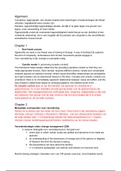
Lecture 1
- Naïve approach: advertising must be effective, because it’s omnipresent and
ad expenditures are big and ever increasing
- Economic approach: correlates ad expenditures with sales volume
- Media approach: ad effectiveness = number of people in target population
who have been exposed to message
- Creative approach: ad effectiveness = creativity
- Psychological approach: seeks to articulate the intrapersonal, interpersonal
or group-level psychological processes that are responsible for the
relationship between ad stimuli and consumer responses
o Scientific psychological approach: ad techniques are not supported
by scientific evidence
Lecture 2
- Explicit attitudes: evaluations that you are consciously aware of and can be
expressed using self-report measures
- Implicit attitudes: evaluations that you are not aware of and that influence
actions/reactions that the individual has little control of
- Attitude ambivalence: liking and disliking something equally at the same time
- Attitude consistency: combines with ambivalence, unless you need to act on
it
- Dual attitudes: challenge the view of attitudes as a unitary construct
- File-drawer model: attitudes are long-lasting
- Attitudes-as-constructions perspective: attitudes change with context
- Attitude stability: depends on attitude strength
- Attitude strength: a strong attitude has high stability, an great impact on
behavior, great influence on information processing, great resistance to
persuasion and are likely stored in memory (and therefore stable)
- Cognitive information: based on reviews, experts, experience
- Heuristics: country of origin, price-quality or brand image
- Affective information: based on experience, conditioning and affect-as-
information
- Mere exposure effect: increased liking for repeatedly presented stimuli
- Behavioral information: self-perception theory, cognitive dissonance
Lecture 3
- Likert scales: questionnaires with analysis
- Semantic differential: good…bad / clean…dirty
- Willingness to pay: how much are you willing to pay?
- Product choice: which product do you prefer?
- Impression management: trying to make a certain impression, so others will
react the way you expect/desire
- Cognitive dissonance: the mental discomfort you experience when you hold
two or more contradictory beliefs, ideas or values
- Bystander effect: acting like other people are acting
Lecture 1
- Naïve approach: advertising must be effective, because it’s omnipresent and
ad expenditures are big and ever increasing
- Economic approach: correlates ad expenditures with sales volume
- Media approach: ad effectiveness = number of people in target population
who have been exposed to message
- Creative approach: ad effectiveness = creativity
- Psychological approach: seeks to articulate the intrapersonal, interpersonal
or group-level psychological processes that are responsible for the
relationship between ad stimuli and consumer responses
o Scientific psychological approach: ad techniques are not supported
by scientific evidence
Lecture 2
- Explicit attitudes: evaluations that you are consciously aware of and can be
expressed using self-report measures
- Implicit attitudes: evaluations that you are not aware of and that influence
actions/reactions that the individual has little control of
- Attitude ambivalence: liking and disliking something equally at the same time
- Attitude consistency: combines with ambivalence, unless you need to act on
it
- Dual attitudes: challenge the view of attitudes as a unitary construct
- File-drawer model: attitudes are long-lasting
- Attitudes-as-constructions perspective: attitudes change with context
- Attitude stability: depends on attitude strength
- Attitude strength: a strong attitude has high stability, an great impact on
behavior, great influence on information processing, great resistance to
persuasion and are likely stored in memory (and therefore stable)
- Cognitive information: based on reviews, experts, experience
- Heuristics: country of origin, price-quality or brand image
- Affective information: based on experience, conditioning and affect-as-
information
- Mere exposure effect: increased liking for repeatedly presented stimuli
- Behavioral information: self-perception theory, cognitive dissonance
Lecture 3
- Likert scales: questionnaires with analysis
- Semantic differential: good…bad / clean…dirty
- Willingness to pay: how much are you willing to pay?
- Product choice: which product do you prefer?
- Impression management: trying to make a certain impression, so others will
react the way you expect/desire
- Cognitive dissonance: the mental discomfort you experience when you hold
two or more contradictory beliefs, ideas or values
- Bystander effect: acting like other people are acting