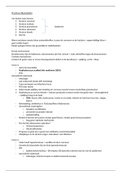
Keller, K.L. (1993). Conceptualizing, measuring, and managing customer-based brand
equity. Journal of Marketing, 57(January), 1-22
The author presents a conceptual model of brand equity from the perspective of the individual
consumer. Customer-Based Brand Equity: the differential effect of brand knowledge on consumer
response to the marketing of the brand (the marketing effects uniquely attributable to the brand).
Brand knowledge
A brand is the sum of these brand identity components: "A name, term, sign, symbol, or design, or
combination of them which is intended to identify the goods and services of one seller or group of
sellers and to differentiate them from those of competitors."
The "associative network memory model" views semantic memory or knowledge as consisting of a
set of nodes and links.
Brand knowledge: is consisting of a brand node in memory to which a variety of associations are
linked. It’s relevant dimensions: brand awareness and brand image.
Brand awareness
Brand awareness: is reflected by consumers' ability to identify the brand under different conditions.
In other words, how well do the brand identities serve their function?
Important in consumer decision making because: Brand needs to be in consideration set, this gives a
brand credits (especially with low involvement), and makes it able to form associations and image.
Consists of:
• Brand recognition: consumers' ability to confirm prior exposure to the brand when given the
brand as a cue → good for decisions in store.
• Brand recall: consumers' ability to retrieve the brand when given the product category, the
needs fulfilled by the category, or some other type of probe as a cue → good for decisions
outside a store (no brand cues).
Brand image
Brand image: perceptions about a brand as reflected by the brand associations held in consumer
memory. Brand associations: the other informational nodes linked to the brand node in memory and
contain the meaning of the brand for consumers.
• Types of brand associations: distinguished by how much information is summarized in it and
they vary according to their favourability, strength and uniqueness.
o Attributes: descriptive features that characterize a product or service.
▪ Product-related attributes: the ingredients necessary for performing.
▪ Non-product-related attributes: external aspects of the product/service: (1)
Price; (2) Packaging/Product appearance; (3) User imagery (consumer); (4)
Usage imagery (in which situations).
o Benefits: personal value consumers attach to the productor service attributes.
▪ Functional benefits: intrinsic advantages, by product-related attributes.
▪ Experiential benefits: what it feels like to use the product, by product-
related attributes.
▪ Symbolic benefits: extrinsic advantages, underlying needs for social approval
and self-esteem, by non-product-related attributes.
o Attitudes: consumers' overall evaluations of a brand: basis of consumer behavior.
Expectancy-value model: attitudes = consumers’ salient beliefs about the product +
evaluative judgements of those beliefs. With few information/motivation, consumers
use simple cues to form attitudes.
equity. Journal of Marketing, 57(January), 1-22
The author presents a conceptual model of brand equity from the perspective of the individual
consumer. Customer-Based Brand Equity: the differential effect of brand knowledge on consumer
response to the marketing of the brand (the marketing effects uniquely attributable to the brand).
Brand knowledge
A brand is the sum of these brand identity components: "A name, term, sign, symbol, or design, or
combination of them which is intended to identify the goods and services of one seller or group of
sellers and to differentiate them from those of competitors."
The "associative network memory model" views semantic memory or knowledge as consisting of a
set of nodes and links.
Brand knowledge: is consisting of a brand node in memory to which a variety of associations are
linked. It’s relevant dimensions: brand awareness and brand image.
Brand awareness
Brand awareness: is reflected by consumers' ability to identify the brand under different conditions.
In other words, how well do the brand identities serve their function?
Important in consumer decision making because: Brand needs to be in consideration set, this gives a
brand credits (especially with low involvement), and makes it able to form associations and image.
Consists of:
• Brand recognition: consumers' ability to confirm prior exposure to the brand when given the
brand as a cue → good for decisions in store.
• Brand recall: consumers' ability to retrieve the brand when given the product category, the
needs fulfilled by the category, or some other type of probe as a cue → good for decisions
outside a store (no brand cues).
Brand image
Brand image: perceptions about a brand as reflected by the brand associations held in consumer
memory. Brand associations: the other informational nodes linked to the brand node in memory and
contain the meaning of the brand for consumers.
• Types of brand associations: distinguished by how much information is summarized in it and
they vary according to their favourability, strength and uniqueness.
o Attributes: descriptive features that characterize a product or service.
▪ Product-related attributes: the ingredients necessary for performing.
▪ Non-product-related attributes: external aspects of the product/service: (1)
Price; (2) Packaging/Product appearance; (3) User imagery (consumer); (4)
Usage imagery (in which situations).
o Benefits: personal value consumers attach to the productor service attributes.
▪ Functional benefits: intrinsic advantages, by product-related attributes.
▪ Experiential benefits: what it feels like to use the product, by product-
related attributes.
▪ Symbolic benefits: extrinsic advantages, underlying needs for social approval
and self-esteem, by non-product-related attributes.
o Attitudes: consumers' overall evaluations of a brand: basis of consumer behavior.
Expectancy-value model: attitudes = consumers’ salient beliefs about the product +
evaluative judgements of those beliefs. With few information/motivation, consumers
use simple cues to form attitudes.