NPTE 3 Exam Questions with Correct Answers
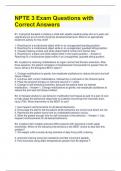
NPTE 3 Exam Questions with Correct Answers B1. A physical therapist is treating a child with spastic cerebral palsy who is 3 years old cognitively but at a 6-month-old gross developmental level. What is an appropriate treatment activity for this child? 1. Reaching for a multicolored object while in an unsupported standing position. 2. Reaching for a multicolored object while in an unsupported, guarded sitting position. 3. Visually tracking a black and white object held 9 inches from his/her face. 4. Reaching for a black and white object while in the supine position. - Answer-2. Reaching for a multicolored object while in an unsupported, guarded sitting position. B2. A patient is receiving mobilizations to regain normal mid thoracic extension. After three sessions, the patient complains of localized pain that persists for greater than 24 hours. What is the therapist's BEST option? 1. Change mobilizations to gentle, low-amplitude oscillations to reduce the joint and soft tissue irritation. 2. Continue with current mobilizations, followed by a cold pack to the thoracic spine. 3. Place the physical therapy on hold and resume in 1 week. 4. Change to self-stretching activities, because the patient does not tolerate mobilization. - Answer-1. Change mobilizations to gentle, low-amplitude oscillations to reduce the joint and soft tissue irritation. B3. A therapist wishes to use behavior modification techniques as part of a plan of care to help shape the behavioral responses of a patient recovering from traumatic brain injury (TBI). What intervention is the BEST to use? 1. Use frequent reinforcements for all desired behaviors. 2. Encourage the staff to tell the patient which behaviors are correct and which are not. 3. Reprimand the patient every time an undesirable behavior occurs. 4. Allow the patient enough time for self-correction of the behavior. - Answer-1. Use frequent reinforcements for all desired behaviors. B4. A patient with multiple sclerosis (MS) presents with dysmetria in both upper extremities. Which of the following interventions is the BEST choice to deal with this problem? 1. 3-lb weight cuffs to wrists during activities of daily living (ADL) training. 2. Isokinetic training using low resistance and fast movement speeds. 3. Pool exercises using water temperatures greater than 85 degrees F. 4. Proprioceptive neuromuscular facilitation (PNF) patterns using dynamic reversals with carefully graded resistance. - Answer-4. Proprioceptive neuromuscular facilitation (PNF) patterns using dynamic reversals with carefully graded resistance. B5. Knee capsular tightness has limited a patientís ability to attain full flexion. An INITIAL intervention a physical therapist can employ to restore joint motion should emphasize sustained mobilization in the loosepacked position. Which of the following is the BEST choice to use? 1. Anterior glide and external rotation of the tibia. 2. Posterior glide and external rotation of the tibia. 3. Posterior glide and internal rotation of the tibia. 4. Anterior glide and internal rotation of the tibia. - Answer-3. Posterior glide and internal rotation of the tibia. B6. A patient recovering from cardiac transplantation for end-stage heart failure is referred for exercise training. The patient is receiving immunosuppressive drug therapy (cyclosporine and prednisone). What guidelines should the therapist follow when implementing an exercise program for this patient? 1. Require longer periods of warm-up and cool-down. 2. Require short bouts of exercise. 3. Eliminate all resistance training. 4. Require a frequency of 2-3 times/week. - Answer-1. Require longer periods of warmup and cool-down. B7. A patient presents with weakness and atrophy of the biceps brachii resulting from an open fracture of the humerus. The therapist reads a report of needle electromyography (EMG) of the biceps. What is the anticipated muscle response after the needle is inserted and prior to active contraction? 1. Polyphasic potentials. 2. Interference patterns. 3. Electrical silence. 4. Fibrillation potentials. - Answer-3. Electrical silence. B8. A new staff physical therapist (PT) on the oncology unit of a large medical center receives a referral for strengthening and ambulation for a woman with ovarian cancer. She is undergoing radiation therapy after a surgical hysterectomy. Her current platelet count is 17,000. What intervention is indicated for this patient at this time? 1. Active range-of-motion (AROM) exercises and activities of daily living (ADLs) exercises. 2. Aerobic exercise 3-5 days/week at 40-60% oxygen uptake reserve. 3. Resistance training at 60%, one repetition maximum. 4. Progressive stair climbing using a weighted waist belt. - Answer-1. Active range-ofmotion (AROM) exercises and activities of daily living (ADLs) exercises. B9. A patient complains of increased pain and tingling in both hands after sitting at a desk for longer than 1 hour. The diagnosis is thoracic outlet syndrome (TOS). Which treatment would be the MOST effective physical therapy intervention? 1. Cardiovascular training using cycle ergometry to reduce symptoms of TOS. 2. Stretching program for the pectoralis minor and scalenes. 3. Strengthening program for the scalenes and sternocleidomastoids. 4. Desensitization by maintaining the shoulder in abduction, extension, and external rotation with the head turned toward the ipsilateral shoulder. - Answer-2. Stretching program for the pectoralis minor and scalenes. B10. A patient with diabetes is exercising. The patient reports feeling weak, dizzy, and somewhat nauseous. The therapist notices that the patient is sweating profusely and is unsteady when standing. What is the therapist's BEST immediate course of action? 1. Insist that the patient sit down until the orthostatic hypotension resolves. 2. Have a nurse administer an insulin injection for developing hyperglycemia. 3. Have the patient sit down and administer orange juice for developing hypoglycemia. 4. Call for emergency services; the patient is having an insulin reaction. - Answer-3. Have the patient sit down and administer orange juice for developing hypoglycemia. B11. A patient with postpolio syndrome started attending a supervised outpatient exercise program. The patient failed to show up for follow-up sessions. The patient reported increased muscle pain and being too weak to get out of bed for the past 2 days. The patient is afraid to continue with the exercise class. What is the therapist's BEST course of action regarding the patient's exercise program? 1. Discharge the patient from the program because exercise is counterproductive in postpolio syndrome. 2. Reschedule exercise workouts for early morning when there is less fatigue. 3. Decrease the intensity and duration, but maintain a frequency of 3 times/week. 4. Decrease the frequency to once a week for an hour session, keeping the intensity moderate. - Answer-3. Decrease the intensity and duration, but maintain a frequency of 3 times/week. B12. A therapist has elected to use continuous inductive coil short wave diathermy (SWD) as one of the interventions in managing hip pain. Use of other thermal or electrical modalities were either ineffective or contraindicated. Which patient would be a candidate for use of short wave diathermy? 1. A morbidly obese patient. 2. A patient with Type 1 diabetes who uses an insulin pump. 3. An 11 year-old boy with a slipped capital femoral epiphysis. 4. A patient with ankylosing spondylitis on high doses of NSAIDS and DMARDS. - Answer-4. A patient with ankylosing spondylitis on high doses of NSAIDS and DMARDS. B13. A patient is recovering from open heart surgery (sternotomy and coronary artery bypass). The PT is supervising the patient's outpatient exercise program at 8 weeks postsurgery. What guidelines should be followed regarding the use of moderate to heavy weights during resistance training? 1. Should include upper body exercises only. 2. Is contraindicated during the first two months. 3. Should be based on 60%-80%, one repetition maximum initially. 4. Can be included if resistance training is once a week. - Answer-2. Is contraindicated during the first two months. B14. A patient with asthma is taking a drug from the sympathomimetic group, albuterol (Ventolin). What is the MOST important effect of this medication? 1. Increases airway resistance and decreases secretion production. 2. Reduces airway resistance by reducing bronchospasm. 3. Increases heart rate (HR) and BP to enhance a training effect during aerobic activity. 4. Reduces bronchial constriction and high blood pressure (BP) that accompanies exercise. - Answer-2. Reduces airway resistance by reducing bronchospasm.
Written for
- Institution
- NPTE
- Course
- NPTE
Document information
- Uploaded on
- May 6, 2024
- Number of pages
- 48
- Written in
- 2023/2024
- Type
- Exam (elaborations)
- Contains
- Questions & answers
Subjects
- npte 3
- npte 3 exam
- npte 3 exam questions
-
npte 3 exam questions with correct answers

Also available in package deal