100% satisfaction guarantee Immediately available after payment Both online and in PDF No strings attached 4.6 TrustPilot
logo-home
Exam (elaborations)

HFL1501 Assignment 6 (ANSWERS) Semester 1 2024 - DISTINCTION GUARANTEED

Rating
-
Sold
3
Pages
6
Grade
A+
Uploaded on
06-05-2024
Written in
2023/2024

Well-structured HFL1501 Assignment 6 (ANSWERS) Semester 1 2024 - DISTINCTION GUARANTEED. (DETAILED ANSWERS - DISTINCTION GUARANTEED!). QUESTION 1 1.1 Read the following statement and answer the question that follows: “South Africa has an uncodified legal system.” In your own words, discuss how this fact impacts on a lawyer who is searching for a remedy with regard to a legal question. (4) 1.2 Name one country of which you have learned in this module that has a codified legal system. (1) [5] QUESTION 2 Name two Constitutional Court cases discussed in the HFL1501 Study Guide that deal with security of tenure. (2) [2] QUESTION 3 3.1 Study the following scenario carefully and answer the question that follows: Buhle and Rita conclude a contract of purchase and sale on 1 March 2024 in terms of which Buhle sells her slowcooker to Rita. They agree that Rita may collect the machine on 10 March 2024. When Rita arrives at Buhle’s house on 10 March 2024, they discover that the slowcooker is missing. Buhle’s house was burgled in July of the previous year, but Buhle did not realise at the time (or at any point thereafter) that the slowcooker was amongst the items stolen from her home. Buhle insists that she and Rita has an agreement and that it is not her fault that the slowcooker is now missing. She demands that Rita still pay the purchase price. Is Buhle entitled to demand that Rita pay the purchase price? Motivate your answer. (4) 3.2 In your own words, discuss how the Consumer Protection Act 68 of 2008 has developed the common law regarding the sale of defective goods. Your answer should be based on your understanding of the discussion in this module’s study material of the law of contract and consumer protection. (4) [8] 3 QUESTION 4 Read the following scenario1 carefully and answer the questions that follow: Facts The three central parties in this case were two attorneys who are partners in a law firm, Mr Alberts and Mr Botha (referred to as the plaintiffs), and Mr Swanepoel (referred to as the defendant). The plaintiffs specialise in the management of deceased estates. In this matter, a conflict arose between the plaintiffs and Mr Swanepoel over a dispute concerning a house in Pretoria North, which had belonged to Mr Swanepoel’s deceased mother. In terms of her will, Mr Swanepoel was his mother’s only heir, which meant that he would ultimately become the owner of the house in question when she passed away. Before her death, Mr Swanepoel’s mother appointed the plaintiffs to handle her estate. Mr Swanepoel was unaware of this, or of the fact that he did not become the owner of the property immediately upon the death of his mother. At the time of her death, Mr Swanepoel was unemployed and he could not afford the ongoing property expenses. Since he was under the impression that he was the owner of the house, he decided to sell it, as he needed the money. Because he had no legal knowledge, he was not aware that the Deeds Registries Act 47 of 1937 or the Alienation of Land Act 68 of 1981 had any relevance to the matter in question; he did not know that the house needed to be formally registered in his name before he could become the owner thereof. Shortly after Mr Swanepoel appointed an estate agent to advertise the property, the plaintiffs discovered that he was trying to sell the house, which he had no legal right to do. The plaintiffs explained to Mr Swanepoel that, before the house was registered in his name, only they, the plaintiffs (who managed his mother’s estate) could sell the house. After the discussion, which severely angered Mr Swanepoel, the plaintiffs allowed Mr Swanepoel's estate agent a certain period within which to sell the property on behalf of the estate (and not on behalf of Mr Swanepoel), either through advertising or per auction. When the house did not sell within the agreed-upon period, the plaintiffs ended the estate agent's mandate. They decided to rather try and sell the property on auction instead, as this would hopefully attract a prospective buyer. The auction proceeded with one serious bidder, who ultimately bought the house. Mr Swanepoel was very disappointed in the amount paid by the purchaser, as he thought the house was worth much more. After the auction and the finalisation of the sale, Mr Swanepoel accused the plaintiffs and the purchaser of conspiring against him. These accusations were directed not only at the involved parties, but also officially reported to several authorities and organisations. Mr Swanepoel reported the plaintiffs to the Legal Practice Council of South Africa, to the Master of the High Court, and to the Office of the Judge President of the High Court. In his communications to these bodies, he made several serious accusations against the 1 This scenario is based on the facts and outcome of an unreported judgment of the North Gauteng Division of the High Court of South Africa (De Wet and others v Scheepers (Unreported) case number 21021/2020 of 27 October 2022). This case is not discussed in the HFL1501 Study Guide. You do not have to find and read the judgment. You do not need to do research or any additional reading on this case or any legal principles applicable thereto. The questions that follow the scenario discussion test your knowledge and understanding of the HFL1501 study material, and not of this case. 4 plaintiffs, including those claiming deceit, unprofessional conduct, blackmail and fraud on their part. Mr Swanepoel’s core accusations against the plaintiffs included the following: 1. That the plaintiffs had knowingly concluded a void contract of purchase and sale; 2. That they had conspired to sell the property at a lower price in order to benefit their friend (the purchaser); 3. That they had used fake names and a front company to acquire the property illegally; 4. That they had sold the property at auction without Mr Swanepoel’s consent; 5. That the main purpose of all their actions in this matter had been to gain financial benefits at the expense of Mr Swanepoel. The plaintiffs contacted Mr Swanepoel multiple times, requesting that he retract these accusations, which they stated were wholly and entirely false. Mr Swanepoel refused to do so. The plaintiffs decided to institute legal action against him in an attempt to restore the good name of their law firm. Legal proceedings The defendant, lacking any legal expertise and not able to afford legal representation, decided to represent himself in court. His defence was poorly presented, highlighting the challenges faced by laypersons in legal proceedings. Throughout the court proceedings, Mr Swanepoel insisted that his statements were truthful, that it was beneficial to the general public, and that it constituted fair comment without malice. However, he could not verify his claims with any evidence. Ultimately, Mr Swanepoel admitted that his statements were indeed intended to damage the plaintiffs' reputation and professional standing. His attitude towards the repercussions of his actions was indifferent; he admitted his wrongdoing without showing concern for the impact of his statements, essentially resigning himself to the consequences of his actions. He attempted to justify his actions by expressing frustration over the sale process and final sale price, which was lower than he had expected. Forensic investigations cleared the plaintiffs of any misconduct, and the complaints to the Master of the High Court and the Legal Practice Council did not lead to further action against the plaintiffs. 4.1 Identify the delict and its specific type, as applicable in the scenario described. (2) 4.2 If ancient Roman law applied to the facts in the scenario, would Mr Swanepoel have been found liable of the delict you identified in 4.1? Explain your answer. (2) 4.3 Assume that Mr Swanepoel is found liable of committing a delict, as set out in these facts. Consider the relevant common-law and constitutional principles relevant to the law of delict as you have learned of them in the HFL1501 study material. If you were 5 the judge in this case, what do you think would be an appropriate order to compel Mr Swanepoel to provide restitution for his wrongdoing? Substantiate your answer. (4) [8] QUESTION 5 Read the following paragraph and answer the question that follows: Two interpretations of ubuntu are mentioned in Learning unit 3 of Part 3 of the HFL1501 Study Guide. These interpretations were formulated by Mokgoro (1995) and Radebe and Phooko (2017). While these interpretations of ubuntu are not in conflict with each other, their focus differs. Identify which one of these two interpretations of ubuntu, if any, you prefer and give reasons for your choice. Your answer must be sufficiently detailed and specific but should not exceed 150 words. (2)

Show more Read less
Institution
Course


Whoops! We can’t load your doc right now. Try again or contact support.

Connected book

Written for

Institution
Course

Document information

Uploaded on
May 6, 2024
Number of pages
6
Written in
2023/2024
Type
Exam (elaborations)
Contains
Questions & answers

Subjects

Content preview

HFL1501
Assignment 6 Semester 1 2024
Unique Number:
Due Date: 9 May 2024

QUESTION 1

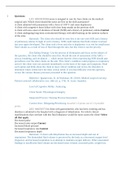
1.1.

The fact that South Africa has an uncodified legal system means that a lawyer searching for a
remedy with regard to a legal question may need to consult multiple sources of law. Instead of
having one single legal code to refer to, the lawyer may need to consider legislation, case law,
common law, custom, indigenous law, and possibly even old writers and authors. This requires
the lawyer to have a comprehensive understanding of the different sources of law and the ability
to effectively navigate and interpret these sources in order to find a suitable remedy for their
DISCLAIMER
client.&ItTERMS
also OF USE that legal research and analysis may be more complex and time-
means
1. Educational Aid: These study notes are designed to serve as educational aids and should not be considered as a
substitute for individual research, critical thinking, or professional guidance. Students are encouraged to
conduct their own extensive research and consult with their instructors or academic advisors for specific
assignment requirements.
2. Personal Responsibility: While every effort has been made to ensure the accuracy and reliability of the
information provided in these study notes, the seller cannot guarantee the completeness or correctness of all
the content. It is the responsibility of the buyer to verify the accuracy of the information and use their own
judgment when applying it to their assignments.
3. Academic Integrity: It is crucial for students to uphold academic integrity and adhere to their institution's
policies and guidelines regarding plagiarism, citation, and referencing. These study notes should be used as a
tool for learning and inspiration, but any direct reproduction of the content without proper acknowledgment and
citation may constitute academic misconduct.
4. Limited Liability: The seller of these study notes shall not be held liable for any direct or indirect damages,
losses, or consequences arising from the use of the notes. This includes, but is not limited to, poor grades,
academic penalties, or any other negative outcomes resulting from the application or misuse of the information
provided.

]

Get to know the seller

Seller avatar
Reputation scores are based on the amount of documents a seller has sold for a fee and the reviews they have received for those documents. There are three levels: Bronze, Silver and Gold. The better the reputation, the more your can rely on the quality of the sellers work.
Edge
Follow You need to be logged in order to follow users or courses
Sold
9777
Member since
2 year
Number of followers
4253
Documents
2721
Last sold
3 hours ago

4.2

1192 reviews

5
671
4
239
3
181
2
28
1
73

Recently viewed by you

Why students choose Stuvia

Created by fellow students, verified by reviews

Quality you can trust: written by students who passed their tests and reviewed by others who've used these notes.

Didn't get what you expected? Choose another document

No worries! You can instantly pick a different document that better fits what you're looking for.

Pay as you like, start learning right away

No subscription, no commitments. Pay the way you're used to via credit card and download your PDF document instantly.

Student with book image

“Bought, downloaded, and aced it. It really can be that simple.”

Alisha Student

Frequently asked questions