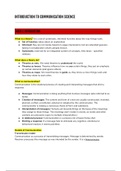
INTRODUCTION TO COMMUNICATION SCIENCE
WEEK 1: INTRODUCTION
What is a theory? I t is a set of systematic, informed hunches about the way things work.
● Set of hunches: i deas about an explanation
● Informed: they are not merely based on vague impressions, but are educated guesses -
taking in consideration what's already known.
● Systematic: r eserved for an integrated system of concepts, links ideas - specified
relations
What does a theory do?
● Theories as nets. W e need theories to u nderstand the world.
● Theories as lenses. T heories influence how we see certain things, they put an emphasis
on certain elements (and ignore others)
● Theories as maps. W e need theories to g uide us, they show us how things work and
how they relate to each other.
What is communication?
Communication is the relational process of creating and interpreting messages that elicit a
response.
● Messages: C ommunication is doing anything that involves m essages (also referred to as
texts).
● Creation of messages: T he content and form of a text are usually constructed, invented,
planned, crafted, constituted, selected or adopted by the communicator. The
communicator is making a conscious choice of form and substance.
● Interpretation of messages: Humans act towards things on the basis of the meanings
they assign to those things. The meanings don’t reside in words, as words and other
symbols are polysemic (open to multiple interpretation.)
● A relational process: Communication is a process not a freeze frame shot.
● Eliciting a response: If a message fails to stimulate any cognitive, emotional or
behavioral reaction, it seems pointless
Models of Communication
Transmission model
Communication as a process of transmitting messages. Message is determined by sender.
Receiver processes this message as was intended by the sender. It is a linear process.
, Expressive model
Communication as not the act of imparting information but as representation of shared beliefs
within a society / group. Emphasis on performance of message (sender). Emphasis on shared
experience of message (receiver). Communication is engaged in for the pleasures of reception.
Examples of the model can be found in the spheres of art, religion and public ceremonies and
festivals.
Publicity model
Communication as a tool to grab and hold attention. Competition between sender for attention
of public. Attention itself is more important than quality of attention. Receiver is spectator
rather than participant.
Reception model
Sender transmits message with a certain purpose/ meaning. Communication 'as' open to
multiple interpretations because of (e.g. social and cultural) differences between receivers, the
same message can have different meanings.
The Empirical Cycle
1. Observation: T he observation of a phenomenon and inquiry concerning its causes.
2. Induction: T he formulation of hypotheses - generalized explanations for the
phenomenon.
3. Deduction: The formulation of experiments that will test the hypotheses. The
deductions of hypothesis as predictions that can be tested is undertaken.
4. Testing: T he procedures by which the hypotheses are tested and data are collected.
5. Evaluation: T he interpretation of the data and the formulation of a theory - uses the
results to present the most reasonable explanation for the phenomenon
Bystanders Do Nothing Experiment
1. Observation: P eople who are faced with an emergency often do nothing if there are
other people present.
2. Induction: I f the numbers of bystanders increases in an emergency, every individual
thinks that someone else will help, so they do not have to do it themselves.
3. Deduction: The more people that are believed to be present during an epileptic
seizure, the less likely the person is to turn to the researcher for help.
4. Testing variables: T he number of people present during an epileptic seizure and the
tendency to turn to the research leader for help.
5. Evaluation: T he hypothesis could be confirmed, and thus the theory of diffusion of
responsibility was further supported
WEEK 2: NEWS PRODUCTION
WEEK 1: INTRODUCTION
What is a theory? I t is a set of systematic, informed hunches about the way things work.
● Set of hunches: i deas about an explanation
● Informed: they are not merely based on vague impressions, but are educated guesses -
taking in consideration what's already known.
● Systematic: r eserved for an integrated system of concepts, links ideas - specified
relations
What does a theory do?
● Theories as nets. W e need theories to u nderstand the world.
● Theories as lenses. T heories influence how we see certain things, they put an emphasis
on certain elements (and ignore others)
● Theories as maps. W e need theories to g uide us, they show us how things work and
how they relate to each other.
What is communication?
Communication is the relational process of creating and interpreting messages that elicit a
response.
● Messages: C ommunication is doing anything that involves m essages (also referred to as
texts).
● Creation of messages: T he content and form of a text are usually constructed, invented,
planned, crafted, constituted, selected or adopted by the communicator. The
communicator is making a conscious choice of form and substance.
● Interpretation of messages: Humans act towards things on the basis of the meanings
they assign to those things. The meanings don’t reside in words, as words and other
symbols are polysemic (open to multiple interpretation.)
● A relational process: Communication is a process not a freeze frame shot.
● Eliciting a response: If a message fails to stimulate any cognitive, emotional or
behavioral reaction, it seems pointless
Models of Communication
Transmission model
Communication as a process of transmitting messages. Message is determined by sender.
Receiver processes this message as was intended by the sender. It is a linear process.
, Expressive model
Communication as not the act of imparting information but as representation of shared beliefs
within a society / group. Emphasis on performance of message (sender). Emphasis on shared
experience of message (receiver). Communication is engaged in for the pleasures of reception.
Examples of the model can be found in the spheres of art, religion and public ceremonies and
festivals.
Publicity model
Communication as a tool to grab and hold attention. Competition between sender for attention
of public. Attention itself is more important than quality of attention. Receiver is spectator
rather than participant.
Reception model
Sender transmits message with a certain purpose/ meaning. Communication 'as' open to
multiple interpretations because of (e.g. social and cultural) differences between receivers, the
same message can have different meanings.
The Empirical Cycle
1. Observation: T he observation of a phenomenon and inquiry concerning its causes.
2. Induction: T he formulation of hypotheses - generalized explanations for the
phenomenon.
3. Deduction: The formulation of experiments that will test the hypotheses. The
deductions of hypothesis as predictions that can be tested is undertaken.
4. Testing: T he procedures by which the hypotheses are tested and data are collected.
5. Evaluation: T he interpretation of the data and the formulation of a theory - uses the
results to present the most reasonable explanation for the phenomenon
Bystanders Do Nothing Experiment
1. Observation: P eople who are faced with an emergency often do nothing if there are
other people present.
2. Induction: I f the numbers of bystanders increases in an emergency, every individual
thinks that someone else will help, so they do not have to do it themselves.
3. Deduction: The more people that are believed to be present during an epileptic
seizure, the less likely the person is to turn to the researcher for help.
4. Testing variables: T he number of people present during an epileptic seizure and the
tendency to turn to the research leader for help.
5. Evaluation: T he hypothesis could be confirmed, and thus the theory of diffusion of
responsibility was further supported
WEEK 2: NEWS PRODUCTION