AAPD QE Exam Questions With 100% Correct Answers
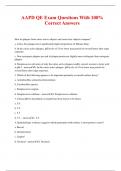
AAPD QE Exam Questions With 100% Correct Answers How do plaques from caries-active subjects and caries-free subjects compare? a. Caries-free plaques have significantly higher proportions of Mutans Strep b. In the caries-active plaques, pH levels of 5.0 or lower may persist for several hours after sugar exposure. c. Non-cariogenic plaques per unit of plaque protein are slightly more acidogenic than cariogenic plaques. d. Streptococcus salivarius of only the caries-active plaques readily convert sucrose to lactic acid at pH 5 - answerb. In the caries-active plaques, pH levels of 5.0 or lower may persist for several hours after sugar exposure. 2. Which of the following appears to be important primarily in smooth-surface decay? a. Actinobacillus actinomycetemcomitans b. Lactobacillus species c. Streptococcus sanguis d. Streptococcus sobrinus - answerd. Streptococcus sobrinus 3. Critical pH for dissolution of enamel has been shown to be about: a. 5.0. b. 5.2. c. 5.5. d. 5.7. - answerc. 5.5. 4. Epidemiologic evidence suggests which permanent tooth surface is most prone to caries? a. Buccal b. Interproximal c. Lingual d. Occlusal - answerd. Occlusal 5. Which best describes the transmission of Mutans streptococci from primary caregiver to child? a. Diagonal b. Horizontal c. Tangential d. Vertical - answerd. Vertical 6. Which drug is known to induce gingival hyperplasia? a. Azathioprine b. Cyclosporine c. Diazepam d. Methotrexate - answerb. Cyclosporine 7. Under the 2017 classification scheme for periodontal and peri-implant diseases and conditions, stages of periodontal disease are based upon: a. age at onset and chronicity. b. anticipated treatment response. c. risk of rapid progression. d. severity and complexity. - answerd. severity and complexity. 8. The primary parameter to define gingivitis cases is: a. bleeding on probing. b. erythema. c. loss of stippling. d. visible plaque. - answera. bleeding on probing 9. Early-onset periodontitis patients having high concentrations of which antibody have significantly less attachment loss than patients who lack this antibody? a. IgA b. IgE c. IgG d. IgM - answerc. IgG 10. Which type of vaccine is the human papilloma virus vaccine? a. Inactivated b. Live-attenuated c. Recombinant d. Toxoid - answerc. Recombinant 11. Innate immunity differs from other types of immune responses due to: a. inability to discriminate between a group of related pathogens. b. increase with repeated exposure to a given pathogen. c. its presence in all individuals at all times. d. mediation by clonal selection of antigen-specific lymphocytes - answerc. its presence in all individuals at all times. 12. Acquired immune responses depend upon: a. granulocytes. b. lymphocytes. c. macrophages. d. polymorphonuclear leukocytes. - answerb. lymphocytes. 13. Opsonization is a process in which antibodies contribute to immunity through: a. activating the proteins of the complement system. b. binding to and neutralizing the pathogen to prevent cell entry. c. coating the surface of a pathogen to enhance phagocytosis. d. lysing microorganisms directly by forming pores in their membranes. - answerc. coating the surface of a pathogen to enhance phagocytosis. 14. Which of the following is a primary organ of the immune system? a. Bone marrow b. Lymph nodes c. Mucosa d. Spleen - answera. Bone marrow 15. Presence of a positive odds ratio indicates: a. a particular exposure does not affect the odds of the outcome.
Written for
- Institution
- AAPD
- Course
- AAPD
Document information
- Uploaded on
- May 6, 2024
- Number of pages
- 56
- Written in
- 2023/2024
- Type
- Exam (elaborations)
- Contains
- Questions & answers
Subjects
-
aapd qe exam questions with 100 correct answers

Also available in package deal