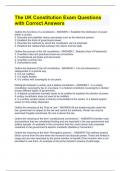
The UK Constitution Exam Questions
with Correct Answers
Outline the functions of a constitution - ANSWER-1. Establish the distribution of power
within a country.
2. Describe and establish various processes such as the electoral system.
3. Establish the limits of government power.
4. Describe the methods by which the constitution can be amended.
5. Establish the relationships between the citizen and the state.
Outline the sources of the UK constitution - ANSWER-1. Statutes (Acts of Parliament)
2. Unwritten rules and practices known as conventions
3. Constitutional principles and documents
4. Unwritten common law
5. Authoritative texts
Outline the features of the UK constitution - ANSWER-1. It is not entrenched or
safeguarded in a special way.
2. It is not codified.
3. It is highly flexible.
4. It is unitary with sovereignty in one place.
Distinguish between a unitary and a federal constitution - ANSWER-1. In a unitary
constitution sovereignty lies in one place. In a federal constitution sovereignty is divided
across different layers of government.
2. A federal constitution normally needs to be codified to establish the division of power.
A unitary constitution does not need to be codified.
3. In a unitary system power is heavily concentrated at the centre. In a federal system
power is more widely dispersed.
Outline the meaning of the 'Rule of Law' - ANSWER-All are treated equally under the
law, government is subject to the law and cannot act arbitrarily. Power can only be
exercised if legally sanctioned. No one is above the law.
Outline the meaning of the term 'constitutional conventions': - ANSWER-Unwritten rules
and practices that are considered binding and are important in the way government and
politics operate. An example is the convention that the Lords cannot veto proposals
contained in the government's election manifesto (Salisbury Convention).
Outline the meaning of the term 'Prerogative powers': - ANSWER-The arbitrary powers
which survive from the time when the monarch had absolute power. These are limited in
range and are now exercised by the prime minister on behalf of the monarch who is not
permitted to use them. An example is the prime minister's powers of patronage.
with Correct Answers
Outline the functions of a constitution - ANSWER-1. Establish the distribution of power
within a country.
2. Describe and establish various processes such as the electoral system.
3. Establish the limits of government power.
4. Describe the methods by which the constitution can be amended.
5. Establish the relationships between the citizen and the state.
Outline the sources of the UK constitution - ANSWER-1. Statutes (Acts of Parliament)
2. Unwritten rules and practices known as conventions
3. Constitutional principles and documents
4. Unwritten common law
5. Authoritative texts
Outline the features of the UK constitution - ANSWER-1. It is not entrenched or
safeguarded in a special way.
2. It is not codified.
3. It is highly flexible.
4. It is unitary with sovereignty in one place.
Distinguish between a unitary and a federal constitution - ANSWER-1. In a unitary
constitution sovereignty lies in one place. In a federal constitution sovereignty is divided
across different layers of government.
2. A federal constitution normally needs to be codified to establish the division of power.
A unitary constitution does not need to be codified.
3. In a unitary system power is heavily concentrated at the centre. In a federal system
power is more widely dispersed.
Outline the meaning of the 'Rule of Law' - ANSWER-All are treated equally under the
law, government is subject to the law and cannot act arbitrarily. Power can only be
exercised if legally sanctioned. No one is above the law.
Outline the meaning of the term 'constitutional conventions': - ANSWER-Unwritten rules
and practices that are considered binding and are important in the way government and
politics operate. An example is the convention that the Lords cannot veto proposals
contained in the government's election manifesto (Salisbury Convention).
Outline the meaning of the term 'Prerogative powers': - ANSWER-The arbitrary powers
which survive from the time when the monarch had absolute power. These are limited in
range and are now exercised by the prime minister on behalf of the monarch who is not
permitted to use them. An example is the prime minister's powers of patronage.