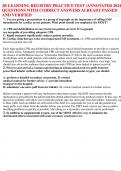
JB LEARNING REGISTRY PRACTICE TEST (ANNOTATED 2024 QUESTIONS WITH CORRECT ANSWERS ALREADY PASSED AND VERIFIED
1. You are giving a presentation to a group of laypeople on the importance of calling EMS immediately for cardiac arrest patients. What point should you emphasize the MOST? A: CPR and defibrillation are key factors in patient survival. B: Laypeople are incapable of providing adequate CPR. C: Rapid transport significantly reduces patient mortality. D: Cardiac drug therapy is the most important EMS treatment.: A: CPR and defibrillation are key factors in patient survival. Early high-quality CPR and defibrillation are the most crucial initial treatments to provide to a patient in cardiac arrest. Adequately performed CPR can keep the heart and brain oxygenated, thus increasing the chance of defibrillation success. Ventricular fibrillation (V-Fib) is the most common initial dysrhythmia seen in adult patients with sudden cardiac arrest and requires prompt defibrillation. Untreated V-Fib will rapidly deteriorate to asystole, the mortality rate from which is very high. You should also advise the audience that compression-only CPR has been linked to patient survival. 2. Prior to your arrival, a woman experiencing an asthma attack took two puffs from her prescribed inhaler without relief. After administering supplemental oxygen, you should: A: perform a detailed secondary assessment. B: contact medical control for further advice. C: provide immediate transport to the hospital. D: administer one more puff from her inhaler.: B: contact medical control for further advice. Before assisting a patient with any medication other than oxygen, the EMT must ensure that the medication is prescribed to the patient and then obtain authorization from medical control. In this case, the physician probably will allow you to help the patient take one more puff from her inhaler. Generally, up to three puffs from an inhaler are delivered in the field. It is important for you to ask the patient how many puffs were taken from the inhaler before you arrived. The EMT must correct any airway and/or breathing problems as quickly as possible. After doing so, a secondary assessment can be performed. 3. In addition to supplemental oxygen, one of the MOST effective way to minimize the detrimental effects associated with acute coronary syndrome is to: A: reassure the patient and provide prompt transport. B: transport the patient rapidly, using lights and siren. C: administer nitroglycerin in 15 to 20 minute intervals. D: request ALS support for any patient who has chest pain.: A: reassure the patient and provide prompt transport. Reason: In addition to increasing the body's oxygen supply with supplemental oxygen, it is extremely important to decrease oxygen demand and consumption. You can most effectively accomplish this by keeping the patient calm, providing reassurance, and providing safe, prompt transport to the hospital. Traveling at a high rate of speed with lights flashing and siren blasting would clearly increase the patient's anxiety and the heart's demand for oxygen. The decision to request ALS support is based on the patient's condition and your transport distance to the closest appropriate hospital. Unless contraindicated (ie, the patient is hypotensive, the medication is not prescribed to the patient), nitroglycerin should be given in 5-minute intervals, up to three (3) doses. 4. The immobilization device MOST appropriate to use for a patient with mul- tiple injuries and unstable vital signs is the: A: scoop immobilization device. B: short spine board immobilization device. C: long spine board immobilization device. D: vest-style immobilization device.: C: long spine board immobilization device. Reason: When caring for a critically injured patient with multiple injuries, the patient's entire body should be immobilized. This is most quickly and effectively accomplished using a long spine board. Vest-style devices or short spine boards take too long to apply and will not provide full body immobilization. The scoop (orthopaedic) stretcher is effective for maneuvering patients in narrow spaces but will not allow for full spinal immobilization because of the vertical opening down the center of the device. 5. Which of the following statements regarding two-rescuer child CPR is cor- rect? A: The chest should not be allowed to fully recoil in between compressions as this may impair venous return B: A compression to ventilation ratio of 15:2 should be delivered without pauses in compressions to deliver ventilations C: The chest should be compressed with one hand and a compression to ventilation ratio of 30:2 should be delivered D: Compress the chest with one or two hands to a depth that is equal to one third the diameter of the chest: D: Compress the chest with one or two hands to a depth that is equal to one third the diameter of the chest Reason: When performing two-rescuer CPR on a child (1 year of age to the onset of puberty [12 to 14 years of age]), the chest should be compressed with one or two hands (depending on the size of the child), and a compression to ventilation ratio of 15:2 should be delivered. It is important to compress the chest to an adequate depth—one third the anterior-posterior diameter of the chest (about 1 1/2" in the child). The chest should be allowed to fully recoil in between compressions in order to maximize venous return to the heart. If an advanced airway device (ie, ET tube, multilumen airway, supraglottic airway) is not in place, two rescuers should deliver "cycles" of CPR; the compressor should pause briefly so the ventilator can deliver two breaths. A compression to ventilation ratio of 30:2 is used for one-rescuer child CPR. After an advanced airway device has been inserted, "cycles" of CPR should not be performed; compressions should be continuous at a rate of at least 100/min and ventilations should be delivered at a rate of 8 to 10 breaths/min (one breath every 6 to 8 seconds). 6. Shortly after assisting a 60-year-old woman with her second nitroglycerin treatment, she tells you that she is lightheaded and feels like she is going to faint. Her symptoms are MOST likely due to: A: a drop in her blood sugar. B: an irregular heartbeat. C: low blood pressure. D: nervousness and anxiety.: C: low blood pressure. Reason: Nitroglycerin (NTG) is a vasodilator; as such, it may cause a drop in blood pres- sure (hypotension) in some patients. Signs and symptoms of hypotension include dizziness, lightheadedness, and fainting (syncope), among others. For this reason,
Written for
- Institution
- JB LEARNING REGISTRY
- Course
- JB LEARNING REGISTRY
Document information
- Uploaded on
- May 4, 2024
- Number of pages
- 128
- Written in
- 2023/2024
- Type
- Exam (elaborations)
- Contains
- Questions & answers
Subjects
- jb learning registry
- jb learning
-
jb learning registry practice test annotated 2024
-
jb learning registry practice test
-
1you are giving a presentation to a group of lay

Also available in package deal