CPHQ Study Guide Questions with Complete Solutions
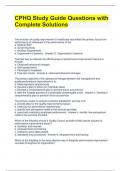
CPHQ Study Guide Questions with Complete Solutions The evolution of quality improvement in healthcare has shifted the primary focus from performance of individuals to the performance of the: a. Medical Staff b. Governing Body c. Ancillary Departments d. Organization's Systems - Answer-D. Organization's Systems The best way to evaluate the effectiveness of performance improvement training is through: a. Observed behavioral changes b. Self-assessments c. Participant's Feedback d. Post-test results - Answer-a. observed behavioral changes The primary objective of the operational linkage between risk management and quality/performance improvement is to: a. Meet regulatory requirements b. Develop a plan of action for individual cases c. Develop a comprehensive plan to prevent future occurrences d. alert the hospital attorney of a potentially compensable event - Answer-c. Develop a comprehensive plan to prevent future occurrences The primary reason to analyze customer satisfaction surveys is to: a. provide data for the quality improvement program b. meet pay-for-performance requirements c. identify how perceptions relate to the services provided d. assist with evaluating employee performance - Answer-c. identify how perceptions relate to the services provided Which of the following should a Quality Council provide to best ensure success of performance improvement teams? a. facilitator and recorder b. empowerment and training c. indicators and a data analyst d. standards and procedures - Answer-b. empowerment and training Which of the following is the most effective way to integrate performance improvement concepts throughout an organization? a. quarterly newsletters b. monthly lectures c. quality teams d. continuous monitoring - Answer-c. quality teams A critical difference between quality assurance (QA) and quality improvement is a shift in focus from: a. retrospective review to concurrent screening b. nonclinical aspects to customer satisfaction c. identifying poor performers to improving group performance d. QA coordinators to teams - Answer-c. identifying poor performers to improving group performance A clinical pathway on the management of hip fractures has been developed by a multidisciplinary team and implemented in a large teaching hospital. After monitoring for 6 months, the length of stay continues to exceed the guidelines. Which of the following should be the next step? a. evaluate compliance with the pathway b. correlate the pathway with staffing levels c. re-educate the staff on the purpose of the pathway d. continue to monitor and collect additional data - Answer-a. evaluate compliance with the pathway `One difference between continuous quality improvement and traditional quality assurance is that quality improvement always a. requires the application of statistical process control b. excludes monitoring and evaluation of care provided c. focuses on systems or processes d. addresses potential problems - Answer-c. focuses on systems or processes
Written for
- Institution
- CPHQ
- Course
- CPHQ
Document information
- Uploaded on
- May 4, 2024
- Number of pages
- 7
- Written in
- 2023/2024
- Type
- Exam (elaborations)
- Contains
- Questions & answers
Subjects
- cphq
- cphq study guide
-
cphq study guide questions with complete solutions

Also available in package deal