FNAN 522 Final Exam
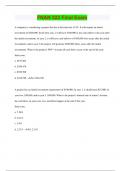
FNAN 522 Final Exam A company is considering a project that has a discount rate of 5%. It will require an initial investment of $200,000. In the first year, it will have $100,000 in net cash inflows (one year after the initial investment). In year 2, it will have cash inflows of $100,000 (two years after the initial investment), and in year 3 the project will generate $200,000 (three years after the initial investment). What is the project's NPV? Assume all cash flows occur at the end of the year. Select one: a. $193,204 b. $190,476 c. $358,708 d. $158,709 - d. $158,709 A project has an initial investment requirement of $100,000. In year 1, it should earn $25,000; in year two, $30,000; and in year 3, $50,000. What is the project's internal rate of return? Assume the cash flows in years one, two, and three happen at the end of the year. Select one: a. 7.56% b. 6.21% c. 5.0% d. 2.21% - d. 2.21% In which of the following situations would it be appropriate to use the IRR method to make an investment decision? Select one: a. All of these answers. b. To compare two projects that have an equal initial investment and lifespan. c. To assess a project which cash flows fluctuate between positive and negative. d. To compare two investments that have different durations. - b. To compare two projects that have an equal initial investment and lifespan. Under the internal rate of return rule in capital budgeting, which of the following statements CANNOT be true? Select one: a. The initial investment can be the cost from purchasing new equipment. b. The internal rate of return can be equal to the cost of capital. c. The internal rate of return can vary throughout the life of a project. d. The cash inflows can be estimates. - c. The internal rate of return can vary throughout the life of a project. You have just been offered a contract worth $5.6 million per year for 3 years. However, to take the contract, you will need to purchase some new equipment. Your discount rate for this project is 15.3%. You are still negotiating the purchase price of the equipment. What is the most you can pay for the equipment and still have a positive NPV? Select one: a. $12.6 million b. $23.4 million c. $5.6 million d. $16.8 million - a. $12.6 million Which of the following could be a sunk cost? Select one: a. All of these answers. b. Equipment purchased to pursue a project. c. A feasibility study that attempted to determine the economic viability of a project. d. Labor hours spent on planning project. - a. All of these answers. Which of the following is an example of an opportunity cost? Select one: a. If you buy a candy bar instead of a soda, the cost is thirst. b. If you watch a game instead of going for a run, the cost is poorer personal health. c. All of these answers. d. If invest in one of two projects, the cost is the lost revenue
Written for
- Institution
- FNAN 522
- Course
- FNAN 522
Document information
- Uploaded on
- May 4, 2024
- Number of pages
- 16
- Written in
- 2023/2024
- Type
- Exam (elaborations)
- Contains
- Questions & answers
Subjects

Also available in package deal