

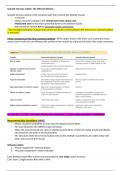
Somatic nervous system- the efferent division
Somatic nervous system in the conscious part that controls the skeletal muscle.
- 1 neurone
- Motor neurone localised in the ventral hole of the spinal cord.
- Myelinated axon sends action potential down to the skeletal muscle.
- Axon terminals release Ach to stimulate muscle contraction.
*One exception being the muscles that control our head is not localised in the spinal cord, instead localised
in the brain*
Motor neurones are the final common pathway- all the upper areas in the brain such as primary motor
cortex, basal nuclei etc can influence the activity of our muscle by acting at the end on the motor neurones.
For somatic, it is ONLY excitation whereas for autonomic, it can be either excitation or inhibition.
Neuromuscular junctions (NMJ)
- Motor neurones send fibres to innervate the skeletal muscle fibres.
- The axon branches into different axon terminals
- When the axon terminals are close to skeletal muscle fibres, it loses its myelin sheath and divides
into branches and ends in terminal buttons.
- The structure when the terminal button ends on the skeletal muscle fibres are called motor end
plate and is part of the muscle.
NMJ has 2 parts:
1. Neural component= terminal button
2. Muscular component= motor end plate
Each skeletal muscle fibre can be only innervated by one single motor neurone.
Can’t have 1 single muscle fibre with 2 NMJ.
Somatic nervous system in the conscious part that controls the skeletal muscle.
- 1 neurone
- Motor neurone localised in the ventral hole of the spinal cord.
- Myelinated axon sends action potential down to the skeletal muscle.
- Axon terminals release Ach to stimulate muscle contraction.
*One exception being the muscles that control our head is not localised in the spinal cord, instead localised
in the brain*
Motor neurones are the final common pathway- all the upper areas in the brain such as primary motor
cortex, basal nuclei etc can influence the activity of our muscle by acting at the end on the motor neurones.
For somatic, it is ONLY excitation whereas for autonomic, it can be either excitation or inhibition.
Neuromuscular junctions (NMJ)
- Motor neurones send fibres to innervate the skeletal muscle fibres.
- The axon branches into different axon terminals
- When the axon terminals are close to skeletal muscle fibres, it loses its myelin sheath and divides
into branches and ends in terminal buttons.
- The structure when the terminal button ends on the skeletal muscle fibres are called motor end
plate and is part of the muscle.
NMJ has 2 parts:
1. Neural component= terminal button
2. Muscular component= motor end plate
Each skeletal muscle fibre can be only innervated by one single motor neurone.
Can’t have 1 single muscle fibre with 2 NMJ.


