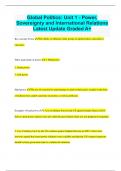
Global Politics: Unit 1 - Power, Sovereignty and International Relations Latest Update Graded A+
Global Politics: Unit 1 - Power, Sovereignty and International Relations Latest Update Graded A+ Key concept: Power The ability to influence other groups in global politics and achieve outcomes. Three main kinds of power 1. Hard power 2. Smart power 3. Soft power Hard power The use of coercion by states/groups to achieve their goals, usually in the form of military force and/or sanctions (economic as well as political). Examples of hard power 1. Use of military force by the US against Islamic State in 2014. Soft or smart power options were not viable because Islamic State was not prepared to negotiate. 2. Use of military force by the US coalition against Saddam Hussein in 2003. Critics have however argued that smart power solutions were available and that the UN weapon inspectors should've been given more time to evaluate the situation. 3. Use of military force by NATO against the Gaddafi regime in Lybia in 2015, where NATO launched an air campaign authorized by UN Security Council. The US was, however, reluctant to participate, because the Obama Administration preferred to focus on withdrawing troops from Iraq and Afghanistan, rather than sending troops to participate in new conflicts. Soft power The use of persuasion or influence by a group or state to achieve outcomes - 'the power to make others want what you want'. States or groups using soft power may use culture, foreign policy or political values to persuade other states. Problems with soft power Critics argue that soft power is not always the best option because it can take years to establish, whereas other forms of power may not take that long. A state's soft power may also be reduced drastically very quickly if they make a decision based on poor political values. For example, Russia's soft power is not very good, due to their discrimination against LGBT people as well as their annexation of the region of Crimea in 2014. Examples of soft power 1. The US' use of development aid to further their own agenda. The United States aid agency (USAID) gives the most aid to countries whose development matters to US security interests, such as in 2015, where Pakistan and Afghanistan were the two countries to receive the most developmental aid from the United States. 2. China's pledge to spend 1.4 trillion dollars on infrastructure investments in Africa has in return granted them access to natural resources in African states. 3. Sporting events, such as the London Olympic Games in 2012, can be used to boost a country's global image. Smart power A combination of the use of hard and soft power - a state or group uses both coercion and persuasion to achieve the desired goal(s). Examples of smart power 1. P5+1 signed a nuclear deal with Japan in 2015. The P5+1 used a mixture of tactics, including diplomatic negotiations (soft power), economic sanctions (hard power) and an unstated but possible threat of military force (hard power). Was referred to by Foreign Affairs Magazine as a textbook example of successfully conceived and implemented foreign policy. 2. Violent groups such as Hezbollah in Lebanon use not only hard power against their adversaries, but also build and run schools, establish and maintain health care facilities, and participate in democratic coalition policies in the Lebanese parliament. Military power Military power is essential with the use of hard power. Military forces (land, air and sea) are the ultimate means to force another group
Written for
- Institution
- Global Politics:
- Course
- Global Politics:
Document information
- Uploaded on
- May 3, 2024
- Number of pages
- 17
- Written in
- 2023/2024
- Type
- Exam (elaborations)
- Contains
- Questions & answers
Subjects
-
global politics unit 1 power sovereignty and i

Also available in package deal