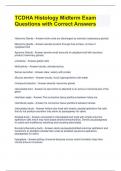
TCDHA Histology Midterm Exam Questions with Correct Answers
TCDHA Histology Midterm Exam Questions with Correct Answers Holocrine Glands - Answer-entire cells are discharged as secretion (sebaceous glands) Merocrine glands - Answer-secrete product through free surface, no loss of cytoplasm/cell Apocrine Glands - Answer-secrete small amounts of cytoplasm/cell with secretory product (mammary glands) unicellular - Answer-goblet cells Multicellular - Answer-tubular, alveolar/acinus Serous secretion - Answer-clear, watery with protein Mucous secretion - Answer-cloudy, mucin (glycoproteins) with water Compound tubularv - Answer-alveolar merocrine glands intercalated duct - Answer-he duct which is attached to an acinus or terminal part of the gland interlobar septa - Answer-The connective tissue partitions between lobes are interlobular septa - Answer-he connective tissue partitions between lobules Intercalated ducts - Answer-hollow tube lined with simple cuboidal epithelium flat cells that do not produce secretion only serve as passageway for saliva Striated ducts - Answer-connected to intercalated duct lined with simple columnar epithelium cells which may have basal striation(mitochondria). Serves as passageway for saliva and modifies by resorbing and excreting electrolytes Excretory/Secretory ducts - Answer-starts as pseudostratified columnar epithelium and transforms to stratified cuboidal then ends as stratified squamous epithelium, passageway for saliva hypoplasia - Answer-pitting of enamel because of poor matrix formation (less than normal amount of enamel Dental fluorosis - Answer-mottled enamel, children exposed to more than 2ppm for 1st 8 years. Fluoride interferes with ameloblasts function Abrasion - Answer-abnormal wear cause by friction due to excessive tooth brushing or use of abrasive toothpastes. Erosion - Answer-tooth structure lost through chemical means such as acid from acid reflux, acidic foods/drinks or vomiting Abfraction - Answer-loss of tooth structure (wedge-shaped lesions) at the cervical neck area of teeth from transmission of forces during occlusion and mastication. Caused by compressive and tensile forces during tooth flexure. What is acinus/acini? - Answer-refers to any cluster of cells What kind of epithelium surrounds the acinus? - Answer-consists of a single layer of cuboidal epithelial cells Salivary glands are - Answer-Compound tubular-alveolar merocrine glands. exocrine glands - Answer-have a duct simple duct - Answer-one duct which does not branch compound duct - Answer-branching of a duct where the secretory unit empties into small ducts and these join to form larger ones. Unicellular shape of Secretory Unit - Answer-Single cell (Goblet) Multicellular shape of Secretory Unit - Answer-Tubular, Alveolar/Acinus merocrine glands - Answer-secrete product through free surface, no loss of cytoplasm/cell EX: salivary glands, pancreas Apocrine glands - Answer-secrete small amounts of cytoplasm/cell with secretory product EX: mammary glands holocrine glands - Answer-entire cells are discharged as secretion EX: sebaceous glands intercalated ducts - Answer-attached to acinus. passageway for saliva striated ducts - Answer-connected to intercalated ducts. cells resorb and excrete electrolytes.
Written for
- Institution
- TCDHA Histology
- Course
- TCDHA Histology
Document information
- Uploaded on
- May 3, 2024
- Number of pages
- 9
- Written in
- 2023/2024
- Type
- Exam (elaborations)
- Contains
- Questions & answers
Subjects
- tcdha
- tcdha histology
-
tcdha histology midterm exam
-
tcdha histology midterm exam questions

Also available in package deal