SPCM 130 CSU exam 1 Questions With Complete Answers.
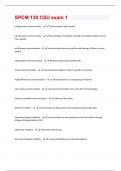
intrapersonal communication - communication with oneself interpersonal communication - the exchange of thoughts, feelings, and beliefs between two or more people small group communication - communication occurring within small groups of three or more people organizational communication - between organizations/leadership cultural communication - communication patterns within a specific community Public/Rhetorical Communication - communication to a large group of listeners mass media communication - Level of communication over some form of technology rhetorical tradition communication - addresses the public Semiotic Tradition - communication as the process of sharing meaning through signs Phenomenological Tradition - communication as the experience of self and others through dialogue (interpretation of life) Cybernetic Tradition - information processing Socio-Psychological Tradition - unravel relationships of individual patternssocio cultural tradition - shared cultural patterns; people produce and reproduce Critical Tradition - communication as a reflective challenge of unjust discourse images of theories - nets, lenses, maps Goal Theories - explain, understand, predict social change Theory - a set of systematic, informed hunches about the way things work Objective Approach - the assumption that truth is singular and is accessible through unbiased sensory observation; interpretive approach - search for rules that guide how humans communicate (qualitative) Ethnography - the method by which researchers attempt to understand a group or culture by observing it from the inside, without imposing any preconceived notions they might have textual analysis - a research method that describes and interprets the characteristics of any text linear model of communication - one-way view of communication that assumes a message is sent by a source to a receiver through a channel interactive model of communication - two-way process of communication where messages flow between sender and receiver transactional model of communication - view of communication as the simultaneous sending and receiving of messages The "I" - spontaneous, impulsive, creative selfThe "me" - the reflective, socially aware self symbolic interaction - interaction between people that takes place through the use of symbols cognitive dissonance - unpleasant mental experience of tension resulting from two conflicting thoughts or beliefs minimal justification - coming up with reasons as to why you do something
Written for
- Institution
- SPCM 130 CSU
- Course
- SPCM 130 CSU
Document information
- Uploaded on
- May 3, 2024
- Number of pages
- 3
- Written in
- 2023/2024
- Type
- Exam (elaborations)
- Contains
- Questions & answers
Subjects

Also available in package deal