NR222: Exam 1 Questions Perfectly Answered!!
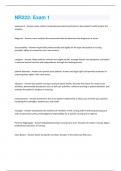
assessment - Answer-nurse collects comprehensive data to pertinent to the patient's health and/or the situation diagnosis - Answer-nurse analyzes the assessment data to determine the diagnoses or issues accountability - Answer-responsible professionally and legally for the type and quality of nursing provided, ability to answer for one's own actions caregiver - Answer-Helps patients maintain and regain health, manage disease and symptoms, and attain a maximal level of function and independence through the healing process patient advocate - Answer-you protect your patient's human and legal rights and provide assistance in asserting these rights if the need arises educator - Answer-you explain concepts and facts about health, describe the reason for routine care activities, demonstrate procedures such as self-care activities, reinforce learning or patient behavior, and evaluate the patient's progress in learning communicator - Answer-essential to the nurse-patient relationship; it allows you to know your patients including their strengths, weaknesses, and needs manager - Answer-Coordinates the activities of members of the nursing staff in delivering nursing care and has personnel, policy, and budgetary responsibility for a specific nursing unit or agency Florence Nightingale - Answer-Established sanitary nursing care units. Founder of modern nursing. began professional education of nursing. Clara Barton - Answer-Nurse during the Civil War; founder of the American Red CrossMother Bickerdyke - Answer-organized ambulance services and walked abandoned battlefields at night, looking for wounded soldiers. Mary Mahoney - Answer-First professionally trained African American nurse; brought cultural diversity and respect Lillian Wald and Mary Brewster - Answer-Opened the Henry Street Settlement, focusing on the health needs of the poor Mary Nutting - Answer-First Nursing professor at Columbia Teachers College. Helped move nursing into universities. health - Answer-A state of complete physical, mental, and social well-being, not merely the absence of disease or infirmity health beliefs - Answer-person's ideas, convictions, and attitudes about health and illness. They may be based on factual information or misinformation, common sense or myths, or reality or false expectations positive health behaviors - Answer-activities related to maintaining, attaining, or regaining good health and preventing illness negative health behaviors - Answer-include practices actually or potentially harmful to health health promotion model focuses on which 3 areas - Answer-(1) individual characteristics and experiences (2) behavior-specific knowledge and effect (3) behavioral outcomes, in which the patient commits to or changes a behavior health promoting behavior - Answer-the desired behavioral outcome and the end point in the HPM. Health-promoting behaviors result in improved health, enhanced functional ability, and better quality of life at all stages of developmenthealth promotion model (HPM) - Answer--defines health as a positive, dynamic state, not merely the absence of disease -directed at increasing a patient's level of well-being Maslow's hierarchy of needs - Answer--model that nurses use to understand the interrelationships of basic human needs -basic human need are elements that are necessary for human survival and health internal variables - Answer-a person's developmental stage, intellectual background, perception of functioning, and emotional and spiritual factors external variables - Answer-a person's health beliefs and practices include family practices, socioeconomic factors, and cultural background Nursing incorporates health promotion activities, wellness education, and illness prevention activities rather than simply treating illness in three ways: - Answer--immunization programs -routine exercise and good nutrition -physical awareness, stress management, and self responsibility primary prevention - Answer-True prevention that lowers the chances that a disease will develop secondary prevention - Answer-Focuses on those who have health problems or illnesses and are at risk for developing complications or worsening conditions tertiary prevention - Answer-Occurs when a defect or disability is permanent or irreversible risk factors - Answer-characteristics or behaviors that increase the likelihood of developing a medical disorder or disease examples: -Genetic and physiological factors -age-environment -lifestyle Precontemplation stage - Answer-no intention of changing behavior Contemplation stage - Answer-considering a change within the next 6 months
Written for
- Institution
- NR222
- Course
- NR222
Document information
- Uploaded on
- May 3, 2024
- Number of pages
- 35
- Written in
- 2023/2024
- Type
- Exam (elaborations)
- Contains
- Questions & answers
Subjects

Also available in package deal