Endocrine Disorder NCLEX Questions fully solved 2024
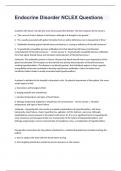
Endocrine Disorder NCLEX QuestionsA patient with Grave's dz asks the nurse what caused the disorder. The best response by the nurse is a. "The cause of Grave's disease is not known, although it is thought to be genetic." b. "It is usually associated with goiter formation from an iodine deficiency over a long period of time." c. "Antibodies develop against thyroid tissue and destroy it, causing a deficiency of thyroid hormones" d. "In genetically susceptible persons antibodies form that attack thyroid tissue and stimulate overproduction of thyroid hormones." - correct answer d. "In genetically susceptible persons antibodies form that attack thyroid tissue and stimulate overproduction of thyroid hormones." (rationale- The antibodies present in Graves' disease that attack thyroid tissue cause hyperplasia of the gland and stimulate TSH receptors on the thyroid and activate the production of thyroid hormones, creating hyperthyroidism. The disease is not directly genetic, but individuals appear to have a genetic susceptibility to become sensitized to develop autoimmune antibodies. Goiter formation from insufficient iodine intake is usually associated with hypothyroidism.) A patient is admitted to the hospital in thyrotoxic crisis. On physical assessment of the patient, the nurse would expect to find a. hoarseness and laryngeal stridor b. bulging eyeballs and arrhythmias c. elevated temperature and signs of heart failure d. lethargy progressing suddenly to impairment of consciousness - correct answer c. elevated temperature and signs of heart failure (rationale- a hyperthyroid crisis results in marked manifestations of hyperthyroidism, with fever tachycardia, heart failure, shock, hyperthermia, agitation, N/V/D, delirium, and coma. Although exophthalmos may be present in the patient with Gravs' dz, it is not a significant factor in hyperthyroid crisis. Hoarsness and laryngeal stridor are characteristic of the tetany of hypoparathyroidism, and lethargy progressing to coma is characteristic of myxedema coma, a complication of hypothyroidism. Preoperative instructions for the patient scheduled for a subtotal thyroidectomy includes teaching the patient a. how to support the head with the hands when moving b. that coughing should due avoided to prevent pressure on the incision
Written for
- Institution
- Nclex
- Course
- Nclex
Document information
- Uploaded on
- May 2, 2024
- Number of pages
- 6
- Written in
- 2023/2024
- Type
- Exam (elaborations)
- Contains
- Questions & answers
Subjects
-
endocrine disorder nclex questions

Also available in package deal