100% satisfaction guarantee Immediately available after payment Both online and in PDF No strings attached 4.2 TrustPilot
logo-home
Exam (elaborations)

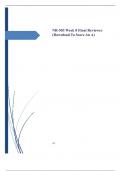
NR-503 Week 8 Final Reviewer (Download To Score An A)

Rating
-
Sold
-
Pages
13
Grade
A+
Uploaded on
01-05-2024
Written in
2023/2024

NR-503 Week 8 Final Reviewer (Download To Score An A) Week 5 1. How does culture influence the decisions a provider may make when selecting an intervention? 2. Explain how culture impacts provi der attitudes? Does it? How will you assess your own attitudes about various cultures/races/groups? 3. Review the terms for this week and apply them to population health; for instance: cultural competence, cultural awareness, norms, values, Kleinman Explanatory Model, socioeconomic status, disparities, minorities, food dessert. o Culture - the practices, beliefs, values, and norms which can be learned or shared, and which guide the actions and decisions of each person in the group o Cultural competence - a dynamic, fluid, continuous process whereby an individual, system or health care agency find meaningful and useful care delivery strategies based on knowledge of the cultural heritage, beliefs, attitudes, and behavior of those to whom they render care. ▪ 4 principles of cultural competence – Caring is designed for the specific client. Care is based in the uniqueness of the person's culture and includes cultural norms and values. Care includes self-employment strategies to facilitate client decisions making to improve health behaviors. Care is provided with sensitivity and is based on the cultural uniqueness of clients. o Cultural awareness - Self-examination of one's own prejudices and biases toward other cultures. An in-depth exploration of one's own cultural/ethnic background o Cultural humility - A lifelong commitment to self-evaluation and self-critiques, redressing the power of imbalances in the patient- physician dynamic, developing mutually. Beneficial relationships o Cultural knowledge - Obtaining a sound educational foundation concerning the various worldviews of differences cultures. Obtaining knowledge regarding biological variations, disease and health conditions and variation in drug metabolism. o Cultural skill - Ability to collect culturally relevant data regarding the client's health history and presenting problem. Ability to conduct culturally based physician assessments. Conducting these assessments in a culturally sensitive manner. o Norms and values - Specific practices that guide their actions and decisions of each person in a group based on their culture. Can be either learned or shared. o Kleinman Explanatory Model - A set of questions the advanced practice nurse can use in order to assess the culture of a patient and proposes that individuals have vastly different notions of health and disease. o Socioeconomic Status - A measure that takes into account three interrelated dimensions: a persons income level, education level, and type of occupation. Some measures of socioeconomic status use only one dimension such as income. o Disparities - A higher burden of illness, injury, disability, or mortality experienced by one group in relation to another. ex. Socioeconomic, health, racial or ethnic o Miniorities - o Food dessert - Neighborhoods and communities that have limited access to affordable fresh and nutritious food o Ethnicity - the aggregate of cultural practices, social influences, religious pursuits, and racial characteristics shaping the distinctive identity of community 4. What are the social determinants of health? How does a provider integrate knowledge of these social determinants of health into their practice? Why are they important? o Things like poverty, education level, racism, income and poor housing that affect access to healthcare. Biology and genetics, individual behavior, social environment, physical environment, and health services. 5. Apply social justice theory to the provision of care; what does social justice mean when applied to health care? o The goal that all people will have equal opportunity to healthcare access and quality of healthcare will be the same 6. What data sources are used to assess determinants of health? o Chronic Disease Indicators. Level of data: state, territory, select large metropolitan areas. The Chronic Disease Indicators enable public health professionals and policy makers to retrieve state and selected metropolitan-level data for chronic diseases and risk factors. o Interactive Atlas of Heart Disease and Stroke. Level of data: national, state, territory, county. The Interactive Atlas of Heart Disease and Stroke enables online county-level mapping of heart disease and stroke by race/ethnicity, gender, and age group. Maps can show social and economic factors and health services for the United States, specific states, or territories. o National Center for HIV/AIDS, Viral Hepatitis, STD, and TB Prevention Atlas. Level of data: national, state, select territories. The Atlas provides interactive maps, graphs, tables, and figures showing geographic patterns and time trends of the reported occurrence of the following diseases: HIV, AIDS, viral hepatitis, tuberculosis, chlamydia, gonorrhea, and primary and secondary syphilis. The data are based on nationally notifiable infectious diseases in the United States and can be used to examine disparities. o National Environmental Public Health Tracking Network. Level of data: national, state, county. The Tracking Network is a system of integrated health, exposure, and hazard information and data from a variety of national, state, and city sources. Maps, tables, and charts with data about environmental indicators (e.g., particulate matter in the air) are available. o The Social Vulnerability Index. Level of data: census tract. The Social Vulnerability Index uses U.S. census variables at tract level to help local officials identify communities that may need support in preparing for hazards, or recovering from disaster. Social vulnerability refers to the resilience of communities when confronted by external stresses on human health, stresses such as natural or human-caused disasters, or disease outbreaks. Reducing social vulnerability can decrease both human suffering and economic loss. o Vulnerable Populations Footprint ToolExternal. Level of data: state, county, city, census tract. The Vulnerable Populations Footprint Tool creates maps and reports that identify geographic areas with high poverty rates and low education levels—two key social determinant indicators of population health. Thresholds for target areas are adjustable, allowing the tool to be used in geographic areas where regional rates may be higher or lower than the national average. (Free registration required to log in to this tool.) Week 6 7. Integrate risk / screening as it applies to genetics? How, what methods are used to screen for health conditions that may have genetic connections? What guidelines support evidence-based decision making in the area of genetics? 8. What is genetic risk assessment? How is it determined? 9. Explore and integrate genetic terminology, for example: Genomics, pharmacogenomics, genetic epidemiology. Also, refer to HP2020. o Genomics - The study of all genes in the human genome as well as their interaction with other genes, the individual’s environment, and the influence of cultural and psychosocial factors. o Pharmacogenomics - Medication efficacy, toxicity, and drug interaction based on genetic variations o Genetic epidemiology - 10. What are the components of a genetic risk assessment? 11. Can you discuss the interplay (connection) between genetics and the environment, how do they influence one another? Do they? 12. What is the Genetics Nondiscrimination Act? o The Genetic Information Nondiscrimination Act (GINA) of 2008 protects Americans from discrimination based on their genetic information in both health insurance (Title I) and employment (Title II). Title I amends the Employee Retirement Income Security Act of 1974 (ERISA), the Public Health Service Act (PHSA), and the Internal Revenue Code (IRC), through the Health Insurance Portability and Accountability Act of 1996 (HIPAA), as well as the Social Security Act, to prohibit health insurers from engaging in genetic discrimination. Week 7 13. Can you discuss the types of outbreaks at a population health level? o Phase 1—None of the current viruses circulating in animals have been reported to cause infection in humans. o Phase 2—An animal-based influenza virus is known to have caused infection in humans and is considered a potential pandemic threat. o Phase 3—An animal- or human-animal-based virus has caused some clusters of cases in people, but has not caused human-to-human transmission that is significant enough to cause community-level outbreaks. o Phase 4—Human-to-human transmission of an animal or human-animal virus is causing community outbreaks and sustained disease. This is a significant shift in risk and any country with such an outbreak should consult with WHO. o Phase 5—There is human-to-human spread of the virus in at least two countries. This phase means that pandemic is imminent and that community action and implementation of planned mitigation procedures is needed. o Phase 6—This is the pandemic phase, characterized by outbreaks in more than one WHO defined region in addition to all Phase 5 criteria (WHO, 2009) o Category 1—case fatality ratio of less than 0.1% and fewer than 90,000 U.S. deaths. Category 2—0.1%-0.5% case fatality ratio and 90,000-450,000 U.S. deaths. Category 3- 0.5%—1% case fatality ratio and 450,000-900,000 U.S. deaths. Category 4—1-2% case fatality ratio and 900,000-1.8 million U.S. deaths. Category 5—greater than 2% case fatality ratio and more than 1.8 million U.S. deaths (CDC, 2014). 14. How is the epidemiological triangle related to pandemics, outbreaks? 15. If you were to explai

Show more Read less


Whoops! We can’t load your doc right now. Try again or contact support.

Document information

Uploaded on
May 1, 2024
Number of pages
13
Written in
2023/2024
Type
Exam (elaborations)
Contains
Questions & answers

Subjects

Content preview

NR-503 Week 8 Final Reviewer (Download To Score An A) HP NR-503 Week 8 Final Reviewer (Download To Score An A)
Week 5
1.How does culture influence the decisions a provider may make when selecting an intervention?
2.Explain how culture impacts provider attitudes? Does it? How will you assess your own attitudes about various cultures/races/groups?
3.Review the terms for this week and apply them to population health; for instance: cultural competence, cultural awareness, norms, values, Kleinman Explanatory Model, socioeconomic status, disparities, minorities, food dessert.
oCulture - the practices, beliefs, values, and norms which can be learned or shared, and which guide the actions and decisions of each person in the group
oCultural competence - a dynamic, fluid, continuous process whereby an individual, system or health care agency find meaningful and useful care delivery strategies based on knowledge of the cultural heritage, beliefs, attitudes, and behavior of those to whom they render care.
▪4 principles of cultural competence – Caring is designed for the specific client. Care is based in the uniqueness of the person's culture and includes cultural norms and values. Care includes self-employment strategies to facilitate client
decisions making to improve health behaviors. Care is provided with sensitivity and is based on the cultural uniqueness of clients.
oCultural awareness - Self-examination of one's own prejudices and biases toward other cultures. An in-depth exploration of one's own cultural/ethnic background
oCultural humility - A lifelong commitment to self-evaluation and self-critiques, redressing the power of imbalances in the patient- physician dynamic, developing mutually.
Beneficial relationships
oCultural knowledge - Obtaining a sound educational foundation concerning the various worldviews of differences cultures. Obtaining knowledge regarding biological variations, disease and health conditions and variation in drug metabolism.
oCultural skill - Ability to collect culturally relevant data regarding the client's health history and presenting problem. Ability to conduct culturally based physician assessments. Conducting these assessments in a culturally sensitive manner.
oNorms and values - Specific practices that guide their actions and decisions of each person in a group based on their culture. Can be either learned or shared.
NR-503 Week 8 Final Reviewer (Download To Score An A)

Get to know the seller

Seller avatar
Reputation scores are based on the amount of documents a seller has sold for a fee and the reviews they have received for those documents. There are three levels: Bronze, Silver and Gold. The better the reputation, the more your can rely on the quality of the sellers work.
NURSEPROCTORIO Chamberlain College Of Nursing
View profile
Follow You need to be logged in order to follow users or courses
Sold
15
Member since
1 year
Number of followers
5
Documents
330
Last sold
4 days ago
Writing and Academics (kianbiden907 at gmail dot com)

I offer a full range of online academic services aimed to students who need support with their academics. Whether you need tutoring, help with homework, paper writing, or proofreading, I am here to help you reach your academic goals. My experience spans a wide range of disciplines. I provide online sessions using the Google Workplace. If you have an interest in working with me, please contact me for a free consultation to explore your requirements and how I can help you in your academic path. I am pleased to help you achieve in your academics and attain your full potential.

Read more Read less
2.0

2 reviews

5
0
4
0
3
1
2
0
1
1

Recently viewed by you

Why students choose Stuvia

Created by fellow students, verified by reviews

Quality you can trust: written by students who passed their tests and reviewed by others who've used these notes.

Didn't get what you expected? Choose another document

No worries! You can instantly pick a different document that better fits what you're looking for.

Pay as you like, start learning right away

No subscription, no commitments. Pay the way you're used to via credit card and download your PDF document instantly.

Student with book image

“Bought, downloaded, and aced it. It really can be that simple.”

Alisha Student

Frequently asked questions