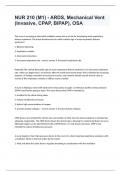
NUR 210 (M1) - ARDS, Mechanical Vent (Invasive, CPAP, BIPAP), OSA with complete solutions 2024
NUR 210 (M1) - ARDS, Mechanical Vent (Invasive, CPAP, BIPAP), OSAThe nurse is assessing a client with multiple trauma who is at risk for developing acute respiratory distress syndrome. The nurse should assess for which earliest sign of acute respiratory distress syndrome? 1. Bilateral wheezing 2. Inspiratory crackles 3. Intercostal retractions 4. Increased respiratory rate - correct answer 4. Increased respiratory rate Rationale:The earliest detectable sign of acute respiratory distress syndrome is an increased respiratory rate, which can begin from 1 to 96 hours after the initial insult to the body. This is followed by increasing dyspnea, air hunger, retraction of accessory muscles, and cyanosis. Breath sounds may be clear or consist of fine inspiratory crackles or diffuse coarse crackles. A nurse is helping a client with obstructive sleep apnea to apply a continuous positive airway pressure (CPAP) mask before going to sleep. The nurse knows that CPAP is intended to: 1. breathe for the client during sleep. 2. reduce intrathoracic pressure. 3. deliver high concentrations of oxygen. 4. prevent alveolar collapse. - correct answer 4. prevent alveolar collapse. CPAP devices are intended for clients who can breathe on their own but need assistance in maintaining adequate oxygenation. The CPAP device keeps the alveoli open, allowing for maximal perfusion to occur. Although oxygen can be administered with a CPAP device, it is not always necessary. CPAP is not intended to reduce intrathoracic pressure. A nurse begins to hear high-pressure alarms in the room of a client requiring respiratory assistance with a ventilator. Which is the best action by the nurse? 1. Wait and allow the client time to regulate breathing in coordination with the ventilator 2. Check ventilator tubing and connections 3. Silence the alarm and restart the ventilator 4. Lower the tidal volumes being delivered to the client - correct answer 2. Check ventilator tubing and connections High-pressure alarms should be immediately investigated by the nurse. Tubing and connections are often a source of both high- and low-pressure alarms. Most frequent cause of high pressure alarms is secretions blocking the tubing. This includes water secretions from the precipitation from the humidifier. Other causes may be kink in the tubing, bronchospasm, ARDS, pneumothorax, or the ET tube becoming displaced into one of the main stem bronchus. Changing the ventilator settings would not change the cause of the problem if it is in- deed external to the client. Waiting or silencing alarms is a threat to client safety. A nurse is caring for a client requiring positive pressure mechanical ventilation. The client has been fighting the ventilator-assisted breaths, and the client's blood pressure has been steadily decreasing. Which would be the most appropriate intervention by the nurse? 1. Place the client in the prone position 2. Notify the respiratory therapist to increase the positive pressure settings 3. Call the physician to suggest sedatives and paralytics 4. Prepare to administer intravenous aminophylline - correct answer 3. Call the physician to suggest sedatives and paralytics keep in mind the hemodynamic effects of mechanical ventilation. With positive pressure ventilation, increased intrathoracic pressure decreases cardiac output resulting to hypotension. Administering appropriate levels of sedation and a paralytic will allow the client to be more relaxed physically and mentally. This state of psychological and physical relaxation allows for greater synchrony with the ventilator. The patient's orders will most likely be changed from A/C mode to Control mode. Adjusting the ventilator settings may assist in reducing client response to ventilation, but in many cases sedatives and paralytics are necessary. Placing the client in the prone position or administering intravenous aminophylline will not be a primary part of correcting the underlying issue.
Written for
- Institution
- ARDS nclex
- Course
- ARDS nclex
Document information
- Uploaded on
- May 1, 2024
- Number of pages
- 25
- Written in
- 2023/2024
- Type
- Exam (elaborations)
- Contains
- Questions & answers
Subjects
-
nur 210 m1 ards mechanical vent invasive cp

Also available in package deal