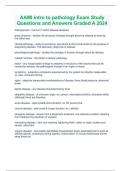
AAMI intro to pathology Exam Study Questions and Answers Graded A 2024
Pathogenesis - manner in which disease develops gross anatomy - studies the structural changes brought about by disease as seen by the naked eye clinical pathology - study of excretions, secretions & other body fluids for the purpose of diagnosing disease. The laboratory diagnosis of disease physiological pathology - studies the changes in function brought about by disease rudolph Virchow - the father of cellular pathology lesion - any recognizable change in anatomy or structure of the tissues that can be caused by disease. the pathological change in an organ or tissue symptoms - subjective complaints experienced by the directly measurable ex: pain, dizziness,itching. signs - objective,measurable manifestations of disease: fever,blood pressure, abnormal pulse. febrile disease - any disease characterized by fever idiopathic disease - of unknown origin. ex; cancer, rheumatoid arthritis, ulcerative colitis (although there are theories) acute disease - rapid onset& short duration. ex TB, pneumonia chronic disease - slow onset & longer duration. ex ; arthritis iatrogenic disease - results from a physicians treatment. any adverse condition resulting from treatment by physician or surgeon fulminating disease - latin root meaning 'lightening flash'. refers to rapid, sudden and severe. often fatal organic disease - has readily identifiable characteristic lesion associated with it such as swollen glands, ulcerations during syphilis, inflammation of mucus membranes during strep throat etc functional disease - has no characteristic lesion. ex: migraine or various mental disturbances. no lesion exists, no anatomical or structural changes occur. nosocomial - pertains to a hospital. often refers to hospital acquired infection. prevalence - refers to number of new and old cases of a disease during a particular period. mortality rate - number of deaths per unit of population. morbidity rate - refers to number of cases of disease per unit of population Endemic disease - more or less present in the community. a disease or agent that is usually present in a population or geographical area at all times. the expected normal incidence of a condition in a certain geographical area or population epidemic disease - attacks a large number of the population in a community at the same time. one whose incidence is beyond that expected by a given population pandemic disease - occurs throughout the world sporadic disease - occurs in neither a endemic or epidemic form. occurring occasionally in a random or isolated manner. factors involved in etiology (cause) of disease - age,race,nutritional status,gender,occupation, emotion & stress, environment, economic status. excitatory causes of disease - conditions that actually cause the disease. physical agents - heat/high temperature, cold/low temperature, electricity,x-rays. chemical agents - compounds that produce some type of cellular swelling; strong acids or bases,drugs,poisons, gases(carbon monoxide). infectious agents - these include various microorganisms viruses,bacteria and parasites adeno - gland ambi - both angio - vessel ante - before anti - against
Written for
- Institution
- AAMI
- Course
- AAMI
Document information
- Uploaded on
- April 30, 2024
- Number of pages
- 18
- Written in
- 2023/2024
- Type
- Exam (elaborations)
- Contains
- Questions & answers
Subjects
- aami intro to pathology
- aami
-
aami intro to pathology exam study questions
-
aami intro to pathology exam

Also available in package deal