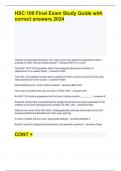
HSC 100 Final Exam Study Guide with correct answers 2024.
How do you identify a health problem within the community? Who does it involve? - answers--look at data and talking to members in the community -look at literature & problems will bubble from community/agency -requires simple logic (perception, opinion) -collection of evidence -personal/environmental factors -involves: members w/in community Who are your potential partners in planning a committee? Which stakeholder will assist you? How will you engage them? - answers-Representative of priority population + doers + influencers + representative of sponsoring agent + other stake holders (person with organization interest) + good leadership = solid committee - need NEW ppl --> generate new ideas - large enough to accomplish work, but small enough to make decisions Find them: hold elections, ask volunteers, inviting/recruiting participants Steps of Needs Assessment? Types of data available? Strengths/limitations? What Q's should a Needs Ass. answer? - answers-Steps: (D.G.A.I.I.V.) 1. Determine Purpose and Scope 2. Gather Data 3. Analyze Data 4. Identify Risk Factors 5. Identify program focus 6. Validating the need Types of Data: Primary Data: data collected yourself (survey, focus groups, interviews) Pros: answers direct q for PP/needs assessment Cons: expensive, great deal of time Secondary data: data collected by someone else, no contact means Pro: already exist, minimal collection time, inexpensive Con: may not fit your PP exactly Q's answered by Needs Ass: -Who are the PP? -Needs of PP? -Why needs exist? -what factors create/determine the need? which subgroups w/in PP have greatest need? located where? -whats currently being done to resolve identified needs? how well have identified needs have been addressed in the past? What are the characteristics of communities? Assumptions made when organizing/building community? - answers--sense of belonging/identity (membership) -common symbols/rituals -shared values/norms/needs (commitment to meet them)/emotional connection Assumptions: 1. communities can develop the capacity to deal with their own problems 2. People want to change and will change 3. people should participate in making changes 4. self-imposed and self developed change is more lasting 5. holistic approach preferred over fragmented approach 6. democracy requires cooperative participation 7. communities need help with problems like individuals do Understanding Diversity - answers--know ppl come from diff backgrounds, edu lvls -ask q's, be aware of differences, get involved w/ small group discussions -seek involvement, input, and listen to persons of diff backgrounds -learn beliefs/feelings of specific groups about particular issues -read about current/emerging issues that concern different groups -learn language, humor, gestures, norms, expectations, values of diff groups -attend events -understand stereotypes, distortions, encountered in media -use examples that range from diff backgrounds/cultures -learn facts before making statements and opinions 5 phases of generalized model and why is it important? - answers-1. Assessing the needs -collecting data to determine health needs of PP 2. setting goals/objectives - whats accomplished 3. developing interventions - how goals/objectives are met 4. implementing interventions -test interventions 5. evaluating results -improve quality teach basic principles of planning and evaluating empashized in most planning models, represents other models What's the intervention mapping model/approach?What are the phases? How's it unique? - answers-translates data collect in precede-procede phases into theoretically bases and appropriate interventions -Phase 1: Conducts Needs Assessment links needs ass. to health outcomes and quality life goals -Phase 2: Creates matrices of change objectives specifies who/what will change from intervention, change in behavior/environment conditions will improve health -Phase 3: Select theory based interventions methods and practical applications -Phase 4: Organize methods and applications into intervention program -phase 5: Plan for adoption, implementation, and sustainability of the program -Phase 6: Generate and evaluate plan Process Objectives - answers-daily tasks, activities, work plans, help shape/form the program process evaluation -by Sept. 2014, staff will conduct 4 focus groups with at least 50 black youths (15-24) in LA to gather input on message content. Impact Objectives - answers-learning, behaviorial, environmental objectives describes immediate effect of program changes in knowledge, attitudes, skills, awareness -By year 2013, the overall gonorrhea incidence rates for 15-24 yr black youths in LA will decrease from 1150 to 800 Outcome Objectives - answers--ultimate objectives, aim to change in health status, social benefits, risk factors, quality of life -By Dec 2011, at least 200 black youths 15-24 in LA who saw the media campaign will report an increase in their retention to use condoms. Informed Consent - answers--P. fully aware of relevant info about program -make sure P. comprehend info -free of coercion -explains nature/benefits of program -give info about alternative programs -tell P. they are free to discontinue anytime -allow P. to ask questions Ethical Issues - answers--situations where competing values are at play and judgment and decisions msut be made on whats appropriate course of action -code of ethics -belmont report: ethical principles/guidelines Define Intervention (treatment), how does it fit in a program? - answers-Define: An acidity or set of activities that help to achieve the outcomes in goals/objectives - planned actions that are designed to prevent disease or injury or promote health in the priority population -ie: get workers to wear seatbelts What questions must be answered in order to select an intervention? - answers-What needs to change? What lvl of prevention? What level's of influence? Any guide for intervention selection? Single or multiple strategies? Appropriate fit for PP? Resources available? What are you aiming to change? Awareness? Knowledge? Behavior? Skill? Environment? Tools use to organize our work to ensure accountability for accomplishment of goals/objectives (logic model, scope of work) - answers-Basic logic model Understand "big picture" Road map that shows relationships b/t: resources available, activities planned, results hoped to be achieved Inputs → activities → outputs → short term → mid term outcomes → long term outcomes -Scope of work Outlines requirements necessary to achieve objectives Breaks down activities into specific tasks with deadlines Identifies work to be performed Lays out specific details of the project Monitors work to be completed Enhances accountability and success of project What resources are in terms of a health problem? - answers-Staffing, space, capacity, multiple! personell, curriculum, instructional resources, supplies, financial resources Basic componets of a budget - answers-A formal statement of the estimated revenues & expenditures -Personnel costs, consultants and contractual costs, supplies, expenses, and equipment costs, travel costs Different sources of funding - answers--Participants fee: Include profit margin (helps program and participants stay in program) (ownership) -3rd Party supportsers: insurance companies (someone other than P. paying) -Cost sharing -Cooperative agreements -Organization/Agency Sponsorship -Grants/Gifts!!!!!!!! from agencies, foundations, groups, and individuals private gov't Whats a grant proposal? - answers-A written document that represents a request for money, a good proposal is one that is well written and explains how the group wishing to receive the money can meet the needs of the funding agency. Define Letter of Intent - answers-Aka Notice of Intent (NOI) Brief summary of your project (including budget) Pre-posal Short, 2-3 pg project description Overall budget figure Common for foundation/corporate grants Helps to have (make ) personal contact What's the purpose of evaluation? What info do we gain? When's it conducted? - answers-Purpose: how broad and successful a program was implemented and degree to which the program influenced knowledge, attitudes, confidence, abilities, and behaviors -Process of determining the value/worth of health promotion program Determine achievements of objectives Improve program implementation Provide accountability to funders and other stakeholders Increase community support Contribute to science - increase understanding of human behavior Inform policy decisions Provide data for future funding requests Why is program planning important? - answers-Program planning allows planners with a direction and gives a framework from which interventions can improve the health of individuals and communities
Written for
- Institution
- HSC
- Course
- HSC
Document information
- Uploaded on
- April 29, 2024
- Number of pages
- 9
- Written in
- 2023/2024
- Type
- Exam (elaborations)
- Contains
- Questions & answers
Subjects
-
hsc 100 final exam study guide with correct answer

Also available in package deal