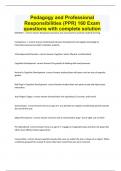
Pedagogy and Professional Responsibilities (PPR) 160 Exam questions with complete solution
Pedagogy and Professional Responsibilities (PPR) 160 Exam questions with complete solution DOMAIN I: -correct Answer-Designing instruction and assessment to promote student learning. Competency 1 -correct Answer-Understands (human development) and applies knowledge to instruction/assessment which motivates students. 4 Developmental Domains -correct Answer-Cognitive, Social, Physical, and Emotional Cognitive Development -correct Answer-The growth of thinking skills and processes. Normal in Cognitive Development -correct Answer-student plays with peers and use toys of opposite gender. Red Flags in Cognitive Development -correct Answer-student does not speak or play and rejects peer interaction. Jean Piaget's Stages -correct Answer-Sensorimotor, Pre-operational, Concrete, and Formal Sensorimotor -correct Answer-Occurs at ages 0-2: are attached to caregiver and develop speech towards the end of first year. Object Permanence -correct Answer-common trait in sensorimotor stage "out of sight, out of mind". Pre-Operational -correct Answer-Occurs at ages 2-7: engages in imaginative play and does not grasp that others have different ideas (egocentric). Conservation -correct Answer-quantity remains the same no matter the size or shape of an object. When a child has grasped this concept it means they have moved from pre-op to concrete. Concrete -correct Answer-Occurs at ages 7-11: demonstrates logical thought and how knowledge is gained through cooperative learning such as group discussions. Reversibility -correct Answer-things can be done, then undone. Formal -correct Answer-Occurs at ages 11 and up: able to research, debate, justify and extend own learning, and student-centered. Social Development -correct Answer-Children learn through culture and develop thoughts based on interactions with others. Zone of Proximal Development -correct Answer-difference between what a learner can do without help and what he/she can do with help. Kohlber
Document information
- Uploaded on
- April 29, 2024
- Number of pages
- 17
- Written in
- 2023/2024
- Type
- Exam (elaborations)
- Contains
- Questions & answers