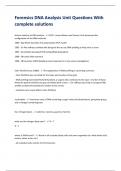
Forensics DNA Analysis Unit Questions With complete solutions
Historic timeline of DNA analysis - 1953 - James Watson and Francis Crick discovered the configuration of the DNA molecule 1980 - Ray White describes first polymorphic RFLP marker 1985 - Sir Alex Jeffreys credited with being the first to use DNA profiling to help solve a crime 1985 - Kary Mullis developed PCR testing (DNA duplication) 1988 - FBI starts DNA casework 1998 - FBI launches CODIS database (most important in crime scene investigation) Colin Pitchfork Case (1986) - first application of DNA profiling to convicting someone - Colin Pitchfork was convicted for the rapes and murders of two girls - DNA profiling exonerated Richard Buckland, a suspect who confessed to the rape + murder of Dawn Ashworth (police believed one guy committed both crimes --> Dr. Jeffreys was hired to compare DNA profiles to determine Buckland's relation to the crime) - matched crime scene DNA to Colin Pitchfork nucleotides - monomer units of DNA containing a sugar molecule (deoxyribose), phosphate group, and a nitrogen-containing base four nitrogen bases - adenine, cytosine, guanine, thymine what are the nitrogen base pairs? - A - T G - C where is DNA found? - found in all nucleated body cells and some organelles (ex: white blood cells, semen, saliva, urine, etc.) - all nucleated cells contain 23 chromosomes - most abundant in buccal (cheek) cells - red blood cells have NO nuclei and, therefore, NO nuclear DNA types of DNA - nuclear and mitochondrial nuclear DNA - found in the nucleus - 23 pairs of chromosomes inherited from both parents - presented in the head of the sperm mitochondrial DNA - found in the mitochondria - mDNA is constructed in a circular or loop - 37 genes are coded for energy generation - inherited only from mother (at conception, the head of the sperm enters the egg and unites with the nucleus; the tail falls off, losing father's mitochondrial DNA) - used when nuclear DNA typing is not possible (ex: skeletal remains, mummy) - analysis of mDNA is more: rigorous, time consuming, costly genes - portions of DNA that code for specific traits or proteins alleles - pairs of genes that encode for a trait karyotype - the specific orders/pairs of known human chromosomes tandem - "next to each other in sequence" true or false: the order of genes and their bases are 99.9% the same except for non-coding regions - true non-coding regions - areas where there is a repeating of the same sequence over and over BUT do not encode for any gene - scientists use these regions to generate a DNA profile of an individual - pose as barriers between genes on a sequence possible explanations for the existence of non-coding regions - - served a function in the past, but are not useful now (evolution) - arisen as a result of mutations or viral ins
Written for
- Institution
- CGC - Certified Genetic Counselor
- Course
- CGC - Certified Genetic Counselor
Document information
- Uploaded on
- April 29, 2024
- Number of pages
- 7
- Written in
- 2023/2024
- Type
- Exam (elaborations)
- Contains
- Questions & answers
Subjects
-
forensics dna analysis unit questions with comple

Also available in package deal