Rasmussen Fundamentals of Nursing - Exam 1 Questions and Answers with complete solution
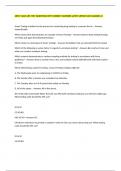
List the types of wellness. - Answer-- Intellectual - Sociocultural - Environmental - Emotional - Spiritual - Physical Give examples of "Physical Wellness". - Answer-Airway, breathing, elimination, food/drink, and mobility. Give examples of "Environmental Wellness". - Answer-Safety and security. Give examples of "Sociocultural Wellness". - Answer-Feelings of love and belonging. Give examples of "Emotional Wellness". - Answer-Feelings of self esteem, fear, sadness, loneliness, or acceptance of self. Give examples of "Intellectual / Spiritual Wellness". - Answer-Self actualization. Having peace and harmony in life, in congruence with values and actions. WHO / AKA - Answer-World Health Organization Define "Health" according to WHO. - Answer-... includes physical, social, and mental components and is not merely the absence of disease or infirmity. Place Maslow's hierarchy of needs in order. - Answer-- Physiological - Safety- Love & Belonging - Esteem - Self-actualization "Physiological Need" includes: - Answer-Physical needs; such as airway, breathing, circulation, elimination, food / drink, and mobility. "Safety Needs" include: - Answer-Environmental, security, housing, and climate. "Love & Belonging Needs" include: - Answer-Sociocultural, family, friends, and coworkers. "Esteem Needs" include: - Answer-Emotional, ear, sadness, loneliness, self-acceptance, and self-esteem. "Self-Actualization Needs" include: - Answer-Intellectual, having peace and harmony. EBP / AKA - Answer-Evidence Based Practice List some Evidence Based Practice barriers. - Answer-- Nursing shortage - Acuity of patients - Nurses skill at reading and evaluating literature - Organizational culture that does not support change - Individual can make changes List the types of knowledge. - Answer-Traditional, Scientific, Authoritarian, and Philosophical. Define "Traditional Knowledge". - Answer-Knowledge passed down from generation to generation. Define "Scientific Knowledge". - Answer-Knowledge obtained through scientific method, and implied through research.Define "Authoritarian Knowledge". - Answer-Knowledge that comes from an expert and is accepted as truth based on the person's perceived expertise. Define "Philosophical Knowledge". - Answer-Knowledge that comes from the developed view point and system of values of an individual. The following are examples of what? - Failure to perceive patient as human being - Failure to listen - Nontherapeutic comments and questions; such as cliches - Using questions requiring only a yes / no answer - Using questions with words "why?" and "how?" - Using questions that probe for information - Using questions that are judgmental or give advice - Changing the subject - Giving false assurance - Gossip - Rumors - Disruptive interpersonal behavior - Bullying - Answer-Barriers to Communication The following are examples of what? - Open-ended questions - Close-ended questions - Validating questions - Clarifying questions- Reflective questions - Answer-Interviewing Techniques Validating Questions are used to do what? - Answer-Confirm what has been heard, and describe the person's feelings. Clarifying Questions are used to do what? - Answer-Gain an understanding of what has been heard; can elicit more information. Reflective Questions are used to do what? - Answer-Report what has been said, and describe person. Define Cultural Shock. - Answer-Feelings, usually negative, that a person experiences when placed in a different culture. Define Cultural Assimilation. - Answer-Losing old culture and adopting a new culture. Define Cultural Blindness. - Answer-The belief that everyone is treated the same within that culture. What is the personal space preference of most Arabic and African individuals? - Answer-Close personal space What is the personal space preference of most Asian and European individuals? - Answer-Distant personal space In what group is the head of the household typically female? - Answer-African-American Describe Dorsiflexion. - Answer-The dorsal surface of the foot moves up Describe Plantarflexion. - Answer-The plantar surface of the foot moves down. SBAR / AKA - Answer-SituationBackground Assessment Recommendation / Respond ISBAR / AKA - Answer-Introduction Situation Background Assessment Recommendation / Respond
Written for
- Institution
- Rasmussen Fundamentals of Nursing
- Course
- Rasmussen Fundamentals of Nursing
Document information
- Uploaded on
- April 29, 2024
- Number of pages
- 11
- Written in
- 2023/2024
- Type
- Exam (elaborations)
- Contains
- Questions & answers
Subjects
-
rasmussen fundamentals of nursing

Also available in package deal