

Renske de Veer (rdeveer)
Summary Targeting cellular processes to treat disease
1. Lectures
Lecture 1. Mitochondrial disorders
Mitochodrial function and disease
Mitochondria play a role in many processes:
- Urea cycle, CAC, Fatty acid oxidation, heme biosynthesis, ATP synthesis, apoptosis, ROS
formation, heat generation, electrical signals, calcium handling
- Due to wide variety of functions, many diseases are linked to mitochondrial dysfunction
o Mitochondrial disease: group of genetically determined metabolic diseases. High
morbidity and mortality, but no treatment. Heterogeneous multi-system. Low
prevalence, rare disease.
- Mitochondrial functioning requires between 1000 -1500 genes:
o mtDNA properties:
▪ 16569 bp
▪ 37 genes: 28 heavy strand, 9 light strand
▪ 13 proteins
▪ 22 tRNA’s
▪ 2 subunits of mitochondrial ribosome
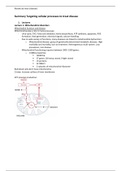
Red blood cells don’t have mitochondria
Cristae: increase surface of inner membrane
ATP (energy) production:
, Renske de Veer (rdeveer)
Increased lactate → acidosis. When there is mitochondrial dysfunction, pyruvate will be converted to
lactate instead of going into the mitochondria for TCA cycle.
Coenzyme Q: oxidant, takes up electrons.
Transport of protons to the outside: Inside of mitochondria has a higher pH compared to the outside,
inside will become negatively charge en outside positively charged
➔ Proton motive force results in protons re-entering the mitochondria.
➔ Electron chemical gradient.
TIM and TOM are translocators from inner and outer membrane respectively.
Summary Targeting cellular processes to treat disease
1. Lectures
Lecture 1. Mitochondrial disorders
Mitochodrial function and disease
Mitochondria play a role in many processes:
- Urea cycle, CAC, Fatty acid oxidation, heme biosynthesis, ATP synthesis, apoptosis, ROS
formation, heat generation, electrical signals, calcium handling
- Due to wide variety of functions, many diseases are linked to mitochondrial dysfunction
o Mitochondrial disease: group of genetically determined metabolic diseases. High
morbidity and mortality, but no treatment. Heterogeneous multi-system. Low
prevalence, rare disease.
- Mitochondrial functioning requires between 1000 -1500 genes:
o mtDNA properties:
▪ 16569 bp
▪ 37 genes: 28 heavy strand, 9 light strand
▪ 13 proteins
▪ 22 tRNA’s
▪ 2 subunits of mitochondrial ribosome
Red blood cells don’t have mitochondria
Cristae: increase surface of inner membrane
ATP (energy) production:
, Renske de Veer (rdeveer)
Increased lactate → acidosis. When there is mitochondrial dysfunction, pyruvate will be converted to
lactate instead of going into the mitochondria for TCA cycle.
Coenzyme Q: oxidant, takes up electrons.
Transport of protons to the outside: Inside of mitochondria has a higher pH compared to the outside,
inside will become negatively charge en outside positively charged
➔ Proton motive force results in protons re-entering the mitochondria.
➔ Electron chemical gradient.
TIM and TOM are translocators from inner and outer membrane respectively.


