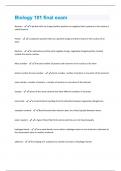
Biology 101 final exam Questions and Answers(A+ Solution guide)
Neutron - A particle with no charge (neither positive nor negative) that is present in the nucleus is called Neutron Proton - a subatomic particle that has a positive charge and that is found in the nucleus of an atom Electron - an elementary particle with negative charge, negatively charged particle; located outside the atomic nucleus Mass number - the total number of protons and neutrons in the nucleus of an atom atomic number & mass number - atomic number- number of protons in one atom of the element. mass number- number of protons + number of neutrons in one atom of the element Isotope - atoms of the same element that have different numbers of neutrons ionic bond - a chemical bond resulting from the attraction between oppositely charged ions nonpolar covalent - Bond formed when electron pairs are shared equally between atoms. polar covalent - a type of bond that forms when electrons are not shared equally hydrogen bonds - very weak bonds; occurs when a hydrogen atom in one molecule is attracted to the electrostatic atom in another molecule adhesion - the clinging of 1 substance to another by means of hydrogen bondscohesion - tendency of molecules of the same kind to stick to one another surface tension - A measure of how difficult it is to stretch or break the surface of a liquid. Water has a high surface tension because of the hydrogen bonding of surface molecules. solute - the dissolved substance in a solution solution - a homogeneous mixture of two or more substances solvent - a liquid substance capable of dissolving other substances acid - compound that donates H+ ions to an aqueous solution and measures less than 7 on the pH scale base - any substance that forms hydroxide ions in water and has a pH above 7 ph - A measure of hydrogen ion concentration equal to -log [H+] and ranging in value from 0 to 14. 4 classes of macromolecules - A. Carbohydrates. B. Lipids. C. Proteins. D. Nucleic Acids. dehydration synthesis - A chemical reaction in which two molecules covalently bond to each other with the removal of a water molecule. hydrolysis - Breaking down complex molecules by the chemical addition of water proteins - contains carbon, hydrogen, oxygen, and nitrogen. source of energy. needed by tissue for repair and growth. made up of 20 amino hydrates - compound made up of carbon, hydrogen, and oxygen atoms; major source of energy for the human body lipids - biochemicals that do not dissolve in water (fats, oils, and waxes) make up cell membranes, store energy nucleic acids - Polymers assembled from individual nucleotides; used to store and transmit hereditary, or genetic, information; the two kinds of nucleic acids are ribonucleic acid (RNA) and deoxyribonucleic acid (DNA) (p. 47). 4 structural levels of a protein - Primary (First), Secondary (Second), Tertiary (Third), Quaternary (Fourth) monomer - a simple compound whose molecules can join together to form polymers polymer - a naturally occurring or synthetic compound consisting of large molecules made up of a linked series of repeated simple monomers
Written for
- Institution
- Biology 101
- Course
- Biology 101
Document information
- Uploaded on
- April 28, 2024
- Number of pages
- 15
- Written in
- 2023/2024
- Type
- Exam (elaborations)
- Contains
- Questions & answers
Subjects

Also available in package deal