BUL 3130 Exam 1 Questions and Answers
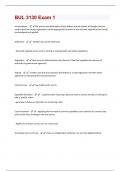
Jurisprudence - the science and philosophy of law, defines several schools of thought that are used to describe various approaches to the appropriate function of law and how legal doctrines should be developed and applied. Ordinance - - Written laws at the local level - Generally regulate issues such as zoning or imposehealth and safety regulations Regulation - Also know as Administrative Law (Source of law that regulates the exercise of authority by government agencies). Statute - - written laws that are passed by the federal or a state legislature and then either approved or rejected by the executive branch. Common Law - Law made by the courts. Equitable Remedies - - a judicial order requiring a party to cease a certain activity, or perhaps to take a specific action. - generally includes an injunction or restraining order. Case Precedent - - Applying the law made in previous appellate court opinions to current cases with similar facts; binding on the trial courts. - Applies to all lower courts, such as a trial court Secondary Sources of Law - - have no independent authority, nor are they legally binding.- Restatements of the Law, a collection of uniform legal principles focused in a particular area of traditional state law. - Various sets of model state statutes drafted by legal experts as a model for state legislatures to adopt in their individual jurisdictions. Rank the laws from most to least supreme - 1. U.S. Constitution 2. Federal Statues & International Agreements (treaty) 3. Federal Administrative Law 4. Federal Common Law 5. State Constitution 6. State Statutory Law 7. State Administrative Law 8. State Common Law (set by states appellate courts) Primary Sources of Law - Constitutional Law Statutory Law Common Law Administrative Law Three Branches of the Federal Government - - legislative branch - executive branch- judicial branch Judicial Review - the notion that federal courts have the right to invalidate state or federal laws that are inconsistent with the U.S. Constitution in some way. Three Categories of Scrutiny - - rational basis category - intermediate-level scrutiny - strict scrutiny Rational Basis Category (Scrutiny) - The government need only show: its action advanced a legitimate government objective (such as public welfare, health, or safety) the action was somehow related to the government's objective. Intermediate-Level Scrutiny - Courts will uphold government actions as constitutional so long as the government can prove: its action advanced an important government objective (a higher level than the "legitimate" criterionused in the rational basis test) the action is substantially related to the government's objective. Strict Scrutiny - Courts will uphold the law only if: government's objective is compelling means chosen by the government to advance that objective are necessary to achieve that compelling less restrictive alternatives exist. Where does Congress gets most of its' power from? (What Clause) - derived from the Commerce Clause whereby Congress is given the power to "regulate Commerce among the several states." Where in the constitution do you get the power of preemption? - The power granted by the supremacy clause to override a state law What amendment contains the equal protection clause? - Fourteenth Amendment. - prohibits state governments from denying their citizens equal protection of the laws. Whose power is limited by the bill of rights? - The Federal Government Where in the constitution are you protected from oppressive and unlawful actions by governments? - Fourth Amendment
Written for
- Institution
- BUL 3130
- Course
- BUL 3130
Document information
- Uploaded on
- April 28, 2024
- Number of pages
- 10
- Written in
- 2023/2024
- Type
- Exam (elaborations)
- Contains
- Questions & answers
Subjects

Also available in package deal