CIPP UK Advanced Payroll - Overpayments exam study guide questions and answers
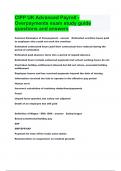
Common Examples of Overpayment Estimated overtime hours paid to employee who could not work the overtime Estimated contracted hours paid then contractual hors reduced during the period of estimation Estimated paid absence turns into a period of unpaid absence Estimated hours include enhanced payments but actual working hours do not Overtaken holiday entitlement allowed but did not return, exceeded holiday entitlement Employee leaves and has received payments beyond the date of leaving Information received too late to operate in the effective pay period Human error Incorrect calculation of statutory deductions/payments Fraud Unpaid leave granted, but salary not adjusted Death of an employee but still paid Definition of Wages - ERA 1996 Salary/wages Bonus/commission/holiday pay SSP SMP/SPP/SAP Payment for time off for trade union duties Remuneration on suspension on medical grounds Not Protected From Having Deductions Taken (not wages under ERA so not protected against unlawful deductions) Redundancy payments are excluded from definition of wages in ERA so not protected against deductions Payments in connection with employees retirement Advance under an agreement for a loan Advance of wages Expenses incurred in carrying out employment Tax refunds Overpayment Impact on Payroll Need to review and try to recover overpayment means extra work Any changed payment records need to be reported to HMRC - trigger HMRC interest if regular problem Unrecovered overpayments - financial cost to company if have to be written off System weakness that employees can take advantage of Disrespect/lack of trust from employees Unrecovered overpayments may lead to court claims Resentful payroll team if not their mistake Stopping Payment If stopping payment would prevent overpayment this should be considered but care is needed to identify the level of risk if this means the payment date will be missed Blocking total pay could be regarded as an unlawful deduction of pay with associated statutory implications Overpayment Procedures It is always prudent to notify the affected employees Inform them of any immediate action that is being taken and negotiate recovery procedures Overpayment due to Late Notification Keep everyone informed of deadline dates Provision of timetables Reminder training Advise on company costs of overpayment Build relationships Audit control Proof of authorisation Overpayment due to Documentation Unambiguous Data Data, forms and documentation not clear Can lead to misinterpretation Effective dates must be clearly indicated to avoid confusion (e.g. start and leave dates) Correct people are authorising changes Annual Leave Overpayment Where employee has received more than they have accrued in entitlement based on the period of employment in that year What to do: contractual provisions through determining when employees can take leave and how payment should be made; limit the amount of annual leave which a new employee can take in first year employed; clearly establish the intention to recover overpaid holiday pay However, such contractual provisions may not be lawful. Annual Leave The Working Time Regulations 1998 - 5.6 weeks minimum statutory entitlement for holiday annual leave Annual leave in excess of statutory amount is outside scope of the regulations and subject to only employee's term and conditions. WTR permits restrictions in first year of employment - only paid for holiday accrued. Irregular earnings - (rolled up holiday is unlawful) processing substitute holiday pay awarded at set points. Accrued holiday is provided on a set timetable, such as a payment on a specific annual date or a quarterly holiday award in order to meet the requirement of the WTR. Dept of Education use a set day for payment of holiday pay to substitute teachers, which implies that Govt has accepted this as a pragmatic approach for irregular working patterns Reducing Overpayments Payroll have - skills, knowledge and understanding Adequate training Clear notification of procedures/guidelines Audit processes Human error major cause of overpayments Testing and verification of systems Exceptional reporting - data anomalies Double checking manual entries Independent checking Leaver Notification Remind leavers of the rules under their contract and manage expectations about what will happen Notify leavers of any holiday payments/holiday recovered or deductions Deductions From Pay ERA 1996 - protection against unauthorised deductions (Section 13) and having to make payments to their employer (Sections 15 & 16) A deduction occurs whenever the employee is not paid what they should be paid on that paydate A non-payment of something that should be paid is treated as a deduction Deductions - lawful - statutory regulations (PAYE, NI, Student Loan, Court Orders), contractual agreement in contract (needs to specify how much is to be recovered, when it is to be recovered and from what payment the recovery is to be made) and voluntary deductions where employee has authorised/agreed for deduction to occur Need a signed authorisation by the employee that payments can be recovered Unlawful Deductions Complaints Employer has clear internal procedures Grievance procedures - failure to resolve the problem within 3 months of the disputed deduction then - Employment tribunal (submission must be made within three months of the date when the wages were due to be paid. Any deduction deemed to be unlawful will result in repayment, in addition to legal costs and court fees. Unjust Enrichment - who deserves the value Kleinwort Benson v Lincoln City Council Overpayment is a mistake Question - who deserves to have money Court will look at: Could the employee have reasonably known they had been overpaid Are there any obvious reasons why repaying should not take place By how much has employee altered their situation/lifestyle How did employer make error How quickly was employee informed of error Had all reasonable measures been taken to effect recovery How as employer behaved in respect of recovery If court finds that employer did not have the correct checks/controls/processes and procedures in place then the employer does not deserve the repayment Estoppel - employee right of defense Occurs when: a) Employer has led the employee to believe that the correct sum of money has been paid (issue if representative of company has indicated to employee that there is no error) b) Employee changed their financial circumstances in good faith (if employee should have realised the payment was not valid, then they cannot reasonably claim they had assumed it was acceptable, and repayment should be expected) c) Overpayment was not cause primarily by the fault of the employee If two parties proceed on the basis of an assumption (whether the assumption proves true or not) neither party can go back on that assumption, without there being potential damages involved If any of the above criteria is not satisfied, then it may be possible to rectify the error, but if all three criteria fail, there would be little chance of getting the overpaid wages back successfully as estoppel would apply If the employee created the situation of overpayment (such as in fraudulent practice) then they cannot claim the error was expected. County Council of Avon v Howlett 1983 Procedures for Handling Overpayments Uniform administrative approach Well documented procedure covering policy & processes Record of when and what has been
Written for
- Institution
- CIPP/US
- Course
- CIPP/US
Document information
- Uploaded on
- April 28, 2024
- Number of pages
- 15
- Written in
- 2023/2024
- Type
- Exam (elaborations)
- Contains
- Questions & answers
Subjects
-
cipp uk advanced payroll overpayments exam

Also available in package deal