TCI (Therapeutic Crisis Intervention) Exam Questions and Answers Already Passed
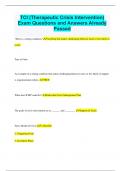
TCI (Therapeutic Crisis Intervention) Exam Questions and Answers Already Passed What is a setting condition? Anything that makes challenging behavior more or less likely to occur. True or False An example of a setting condition that makes challenging behavior more or less likely to happen is organizational culture. TRUE What does ICMP stand for? Individual Crisis Management Plan The goals of crisis intervention are to _______ and ________. Support & Teach Stress Model of Crisis 1. Baseline 2. Triggering Event 3. Escalation Phase 4. Outburst Crisis 5. Recovery What are the four questions that we ask ourselves before intervening in a potential crisis? 1. What am I feeling now? 2. What does this child feel, need, or want? 3. How is the environment affecting the child? 4. How do I best respond? Behavior Support Techniques (need to know 4) 1. Managing the environment 2. Prompting 3. Caring gesture 4. Hurdle help 5. Redirection and distractions 6. Proximity 7. Directive statements 8. Time away What are the three goals of emotional first aid? **Be able to write these out 1. Co-regulation (provide immediate help and support to reduce emotional intensity) 2. Resolve the immediate crisis 3. Re-enter the child back into the program Strategies for Emotional First Aid **Need to know terms and be able to write them out 1. Drain off emotions 2. Clarify events 3. Maintain the relationship and lines of communication 4. Remind the child of expectations and mediate the situation if necessary Conflict Cycle 1. Stressful situation/incident 2. Young person's feelings 3. Young person's behavior 4. Adult's response Avoid the conflict cycle by: **Know at least four of these and be able to write them out! 1. Listen and validate the child's feelings 2. Manage the environment 3. Give the young person choices and the time to decide what to do next. 4. Redirect the young person to another positive activity 5. Appeal to the young person's self interest 6. Drop or change the expectation 7. Use positive self-talk Reactive vs. Proactive Aggression Reactive Aggression -emotions are dominant -loss of control and emotional flooding -eg. impulsive, angry, loud, highly aroused emotions
Written for
- Institution
- TCI
- Course
- TCI
Document information
- Uploaded on
- April 27, 2024
- Number of pages
- 11
- Written in
- 2023/2024
- Type
- Exam (elaborations)
- Contains
- Questions & answers
Subjects
-
tci therapeutic crisis intervention exam questio

Also available in package deal