

SYNTHESIS
BOND FISSION
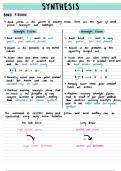
Bond fission is the process of breaking bonds There are two types of bond
fission homolytic and hetero
lytic
Homolytic Fission Heterolytic Fission
Bond breaks I e moves to each Bonds break 2 e move to only
species free radicals formed one species ions are formed
Results in the formation
radicals
of two neutral Results in the formation of two
oppositely charged ions
occurs when each atom retains one Occurs when one atom retains both
electron from the 0 covalent bond from the co covalent bondand
electrons
and the bond breaks evenly the bond breaks unevenly
A
A B
w A t B A B At t B
polar covalent B A
Normally occurs when non
bonds are broken and can be
Aj t B
initiated by UV light Normally occurs when polar covalent
bonds are broken
Reactions involving homolytic fission tend
to result in the formation of very Reactions involving heterolylic fissions
complex mixtures of products making tend to result in far fewer products
them unsuitable for organic synthesis than reactions involving homolytic fission
and so are better suited for organic
synthesis
The movement of electrons during bond fission and bond making can be
represented using curly arrow notation
Fish hook Arrow Curly Arrow
single electron source electron pairsource
i
TilEi 2e I
single electron destination electron pair destination
,
BOND FISSION
Bond fission is the process of breaking bonds There are two types of bond
fission homolytic and hetero
lytic
Homolytic Fission Heterolytic Fission
Bond breaks I e moves to each Bonds break 2 e move to only
species free radicals formed one species ions are formed
Results in the formation
radicals
of two neutral Results in the formation of two
oppositely charged ions
occurs when each atom retains one Occurs when one atom retains both
electron from the 0 covalent bond from the co covalent bondand
electrons
and the bond breaks evenly the bond breaks unevenly
A
A B
w A t B A B At t B
polar covalent B A
Normally occurs when non
bonds are broken and can be
Aj t B
initiated by UV light Normally occurs when polar covalent
bonds are broken
Reactions involving homolytic fission tend
to result in the formation of very Reactions involving heterolylic fissions
complex mixtures of products making tend to result in far fewer products
them unsuitable for organic synthesis than reactions involving homolytic fission
and so are better suited for organic
synthesis
The movement of electrons during bond fission and bond making can be
represented using curly arrow notation
Fish hook Arrow Curly Arrow
single electron source electron pairsource
i
TilEi 2e I
single electron destination electron pair destination
,


